


Key Takeaways:
- Ms. Rachel published a “Free Palestine” post on Instagram and liked a comment stating, “Free America from the Jews.”
- Although she later removed the post and claimed in a tearful apology that the engagement was accidental, her actions fit a broader pattern of antisemitic misinformation shared with her millions of followers.
- Taken together, Ms. Rachel’s repeated engagement with antisemitic narratives raises serious questions about accountability, intent, and the responsibility that comes with her global influence.
Everyone has accidentally liked a post while mindlessly scrolling through social media. But when that “accident” becomes multiple engagements with blatantly antisemitic comments – alongside posts that are explicitly antisemitic – it can no longer be dismissed as clumsy thumbs on a small phone screen. It reveals a pattern of behavior that points to something far more troubling about the underlying beliefs held by that person.
That is exactly what Ms. Rachel herself has proved, when, this past week, screenshots revealed her liking a comment that read “Free America from the Jews” on a post of hers which called for a “Free Palestine, Free Sudan, Free Congo, Free Iran.”
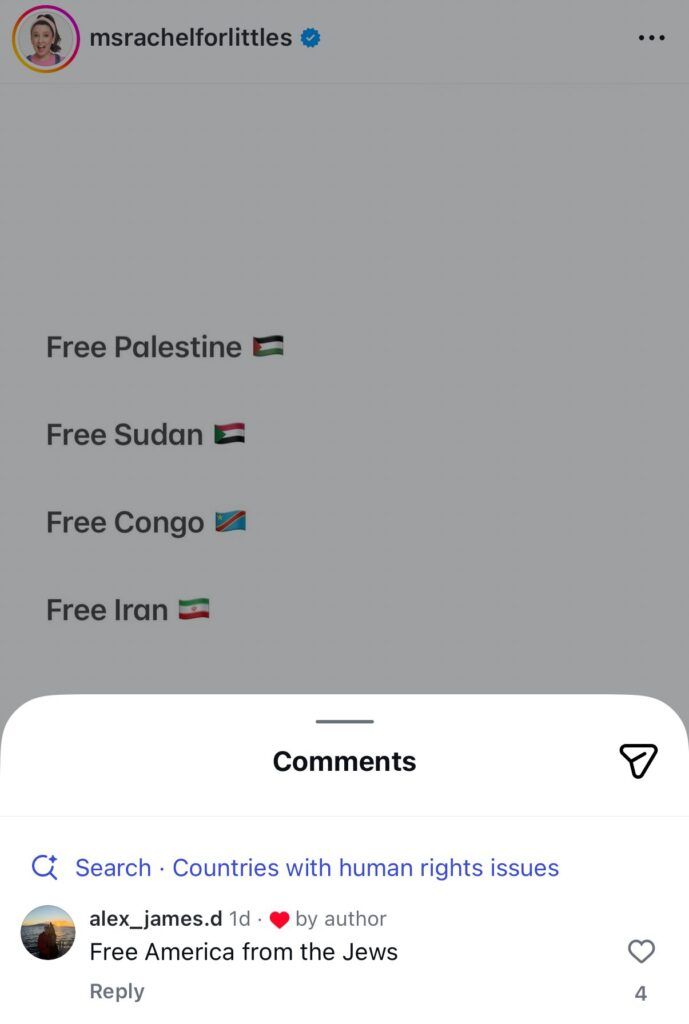
When a fan messaged Ms. Rachel privately to make her aware of the like, she responded that, of course, it was an accident, and reassured that “I hate antisemitism.” But this statement would be much easier to believe if Ms. Rachel didn’t previously have a pattern of explicit antisemitic messaging.
Was it merely an “accident,” then, that she collaborated with Motaz Azaiza, a Palestinian photojournalist who publicly called on followers to join the “resistance” and praised the eliminated Hamas leader Yahya Sinwar? Or that she has repeatedly accused Israel of committing a genocide – claims that have been thoroughly debunked? Was it also accidental when she shared an image of a Gazan child while alleging Israel was systematically starving Palestinians, omitting the fact that there was no famine and that the child was suffering from a congenital condition?
View this post on Instagram
When Ms. Rachel released a nearly two-minute, tearful “apology,” she again attempted to frame the incident as an innocent mistake, insisting that liking the original comment was accidental. Yet even in that moment, her conduct undercut the claim.
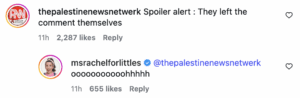
She then immediately engaged positively with a comment from The Palestine News Netwerk – an Instagram account that has praised Yahya Sinwar and harassed Jews in public – suggesting that “they,” meaning the Jews, “left the comment themselves.”
This is not a matter of clumsy thumbs or a lack of social-media fluency. Ms. Rachel is acutely aware of the record she is building and the audience watching it unfold. Her growing alignment with increasingly radical voices, including recent collaborations with New York City Mayor Zohran Mamdani, underscores that awareness rather than undermines it.
What makes this especially alarming is Ms. Rachel’s global reach. She is a household name. Children adore her and parents trust her. When her fixation on Israel begins to dominate her platform, it is often waved away as “advocacy,” rather than scrutinized for the misinformation and antisemitic tropes it repeatedly amplifies.
Influence carries responsibility, particularly when it extends into millions of homes and classrooms. When that influence is used to distort facts, legitimize antisemitic narratives, or normalize hostility toward Jews, it ceases to be activism and becomes something far more dangerous.
So if Ms. Rachel insists she would “never agree with an antisemitic thing like the comment,” then her actions still betray her. Removing a “like” or comment and offering tearful explanations does not erase the normalization of hate. When this conduct repeats, it stops being careless and becomes disqualifying for someone positioned as a safe figure for children.
Liked this article? Follow HonestReporting on Twitter, Facebook, Instagram and TikTok to see even more posts and videos debunking news bias and smears, as well as other content explaining what’s really going on in Israel and the region. Get updates direct to your phone. Join our WhatsApp and Telegram channels!