


Key Takeaways:
-
Rafah’s reopening is a security-conditioned ceasefire measure, not a humanitarian gesture, with Israel enforcing strict inspections due to smuggling and terror risks.
-
Media outlets portrayed Rafah as an Israeli choke point while omitting Egypt’s parallel restrictions.
-
By erasing Egypt’s role and Rafah’s history, coverage misleads readers into thinking Israel is arbitrarily “trapping” Gazans rather than managing a long-standing security threat.
The Rafah Crossing is the main gateway between the Gaza Strip and Egypt. Its partial reopening this week is not supposed to be a feel-good “breakthrough.” It is a tightly managed security arrangement embedded in a U.S.-brokered ceasefire framework, with Israel explicitly limiting movement and screening travelers out of concern that terrorists or weapons could move through the corridor.
Those are the basic facts. And they matter, because the way Rafah is framed in international coverage often leaves readers with the impression that Israel is “trapping” Gazans for no clear reason, as if the crossing was a simple humanitarian valve that Israel can open or close at will. It is not.
Security Measures
Israel’s position is straightforward. It is allowing a reopening, but with controls. Prime Minister Benjamin Netanyahu was quoted describing the core condition: “Anyone entering or exiting undergoes our inspection, a full inspection.” In Reuters’ account, the reopening was properly described as limited and conditional, tied to security screening and operational constraints.
That security logic is not abstract. Rafah has long been wrapped up in smuggling and terror activity. Even an Associated Press report notes that for years, “Egypt imposed a blockade on Gaza,” while a tunnel economy thrived under the border, which Palestinian terror groups used to build their arsenals. That history helps explain why any reopening is contested, and why Israeli authorities insist on restrictions.
But The Washington Post, for example, erased Egypt’s role and included the following paragraph, making Israel look like it was “trapping” Gazans inside the enclave for no reason:
The Israeli military seized the border in May 2024 as it swept through Rafah in southern Gaza, displacing nearly 1 million people who had sought refuge there. It then closed the crossing to pedestrian and other traffic, trapping Gaza’s roughly 2 million people — including those who were severely sick or injured — for the majority of the war.
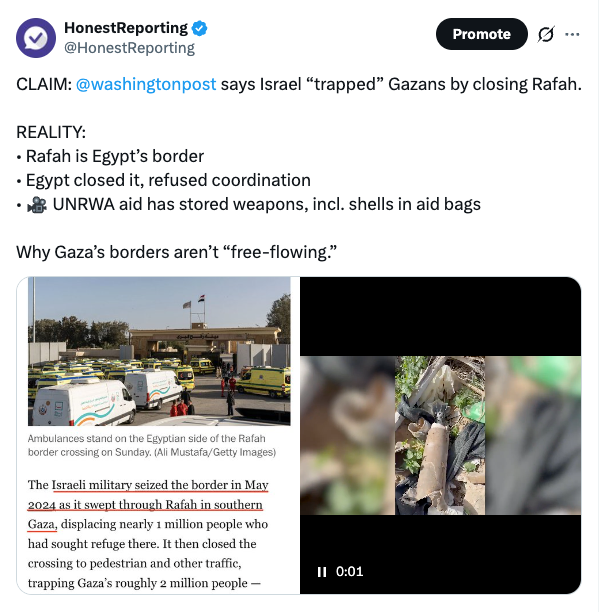
And The New York Times did not mention Egypt’s past partial blockade, nor the risk of terror tunnels. Similarly, The Wall Street Journal omitted the crucial Egyptian context, making it seem like Israel has sealed the crossing after it had been wide open for years.
LEFT: @WSJ says Rafah has been closed since Israel took control in March 2024.
RIGHT: Reuters reports Egypt rejected coordination to reopen Rafah – why it stayed closed.
Also: Israel took control in May 2024, not March.
The context isn’t optional. pic.twitter.com/VR5DccCEDp
— HonestReporting (@HonestReporting) February 3, 2026
CNN led with the following line, completely ignoring Egypt’s part:
The crucial crossing, which has been largely closed since Israel seized it in May 2024, underwent a series of preparations…
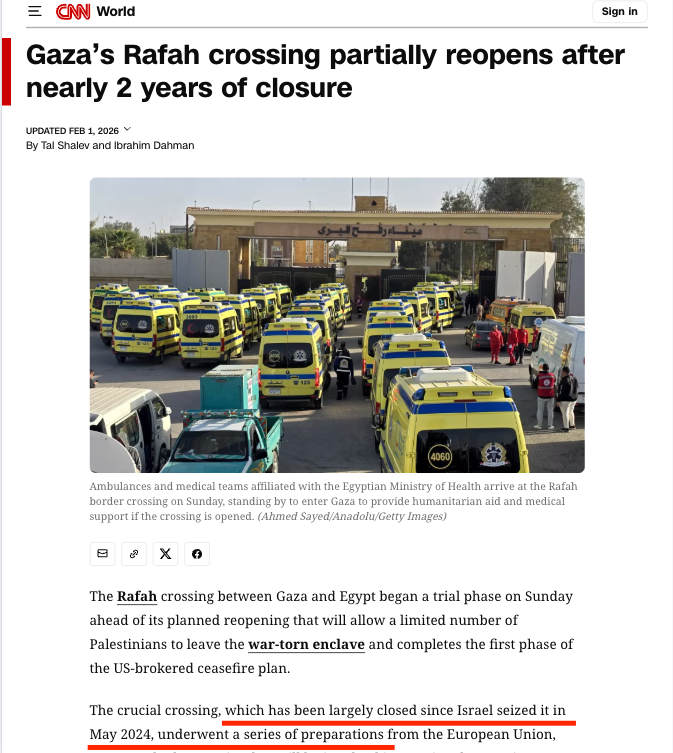
France24 also failed to mention Egypt’s historic role. Instead, the outlet platformed sick Gazans waiting to cross, implicitly blaming Israel for their plight.
Coverage that omits Rafah’s security risk and presents it solely as an Israeli lever erases the reality that Cairo has repeatedly treated the crossing as a national security pressure point, not just a humanitarian gateway. Even the wire services mentioned this, so leaving no excuse for media outlets to omit it, other than ignorance, sloppiness, or — far more likely — bias.
The story, then, is not merely that Israel is restricting movement at Rafah. It is that movement is being restricted because the crossing has long been linked to weapons smuggling, terror activity, and terrorist infrastructure — risks that prompted not only Israeli controls, but years of parallel restrictions by Egypt as well.
That distinction is crucial. When coverage leans on emotionally charged claims of Gaza being sealed off, without confronting the security realities that made Rafah a flashpoint in the first place, it leaves readers with an incomplete understanding of why this crossing has never operated like a normal civilian border.
Liked this article? Follow HonestReporting on Twitter, Facebook, Instagram and TikTok to see even more posts and videos debunking news bias and smears, as well as other content explaining what’s really going on in Israel and the region. Get updates direct to your phone. Join our WhatsApp and Telegram channels!