Key Takeaways:
- Susan Abulhawa has openly endorsed political violence and repeatedly used antisemitic rhetoric about Jews and Israelis.
- Simon & Schuster is nevertheless republishing two of her novels this September, complete with fresh promotion and institutional backing.
- That decision sits uneasily with the publisher’s past willingness to cancel authors over conduct it said conflicted with its “larger public responsibility.”
To say that Susan Abulhawa is a controversial figure would be an understatement. For years, through her public statements and speaking engagements, she has repeatedly trafficked in antisemitic rhetoric and expressed support for political violence. Yet Simon & Schuster has stood by its decision to republish her work this September.
Simon & Schuster has previously shown that an author’s conduct can be serious enough to end a publishing relationship. In 2021, the company canceled Republican Senator Josh Hawley’s planned book following the challenge to the 2020 election results, saying at the time that although it sought to publish a range of viewpoints, it also took seriously its “larger public responsibility.”
Years earlier, the publisher canceled Milo Yiannopoulos’s planned book Dangerous after remarks resurfaced in which he appeared to defend sexual relationships between adult men and minors.
Both cases made clear that Simon & Schuster considers an author’s public conduct relevant to whether it will continue to publish and support them. That makes its decision to stand by Susan Abulhawa all the more striking.
Atria Books, a Simon & Schuster imprint, is set to republish two of Abulhawa’s novels, Mornings in Jenin and The Blue Between Sky and Water, on September 29, 2026. The new editions are already being actively promoted, with the publisher praising Abulhawa’s “signature lyrical voice” and “nuanced characters.”
That same voice has also been unequivocal in its support for political violence.
During a May 2026 public conversation in Slovenia, Abulhawa said she “wholeheartedly” embraced armed and violent resistance and described it as “the only way” forward. She later praised Kozo Okamoto, a participant in the 1972 Lod Airport massacre that killed 26 people, as an embodiment of solidarity and love.
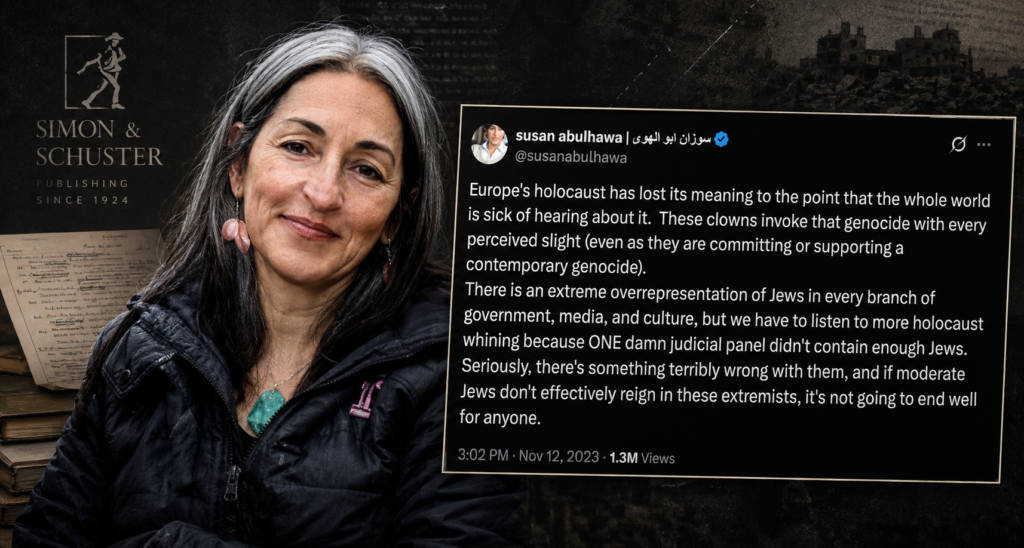
Her rhetoric about Jews and Israelis has been similarly extreme, going far beyond political criticism of Israel or its government. She has described Jews and Israelis as “demons,” “monsters,” “parasites,” “ghouls” and “cockroaches.” She has also spread antisemitic conspiracy theories about the supposed “extreme overrepresentation of Jews” in government, media and culture, invoked “dual loyalty,” and referred to “Jewish supremacist vampires.”
Her comments about the Holocaust have been no less extreme. In one recent post, she said Europe’s Holocaust had “lost its meaning,” complained about “holocaust whining,” and said the world was tired of hearing about it. In another, she suggested that Jewish behavior had helped create the conditions that led to the Holocaust, before warning that history could repeat itself.
These are not old remarks being unearthed years later. They form part of Abulhawa’s current public persona at the very moment Simon & Schuster is preparing to invest fresh resources in her work. Republishing the books means a new marketing campaign, renewed sales outreach, fresh promotional material and another round of institutional backing from one of the country’s largest publishing houses.
Simon & Schuster does not have to agree with every opinion expressed by every author it publishes. But its own history shows that it does not regard an author’s conduct as irrelevant. The question, then, is what standard is being applied to Susan Abulhawa.
Why were the actions or comments of Hawley and Yiannopoulos serious enough to affect their planned publications, while praise for political violence and repeated antisemitic rhetoric have apparently not prompted Atria to reconsider Abulhawa’s republication?
That question becomes even harder to ignore because Abulhawa herself appears to recognize that her rhetoric carries consequences. In a recent interview, she discussed people distancing themselves from her, including Zohran Mamdani, who has himself been sharply critical of Israel but nevertheless publicly described her rhetoric as “patently unacceptable” and “reprehensible” when asked about her association with his wife.
Simon & Schuster is entitled to continue publishing Susan Abulhawa. But having previously invoked its own “larger public responsibility” when severing ties with other authors, it should be prepared to explain why a different standard appears to apply here.
Nor is it the only literary institution involved. Abulhawa’s books have also been published by Bloomsbury, Just World Books and Women Unlimited, while she is represented for speaking engagements by Pande Lecture Management, an agency affiliated with Pande Literary.
Pande Lecture Management works with universities, libraries, nonprofits and other institutions, and presents its speakers as contributors to conversations about equity, belonging and pluralism. That makes the standards governing whom such institutions choose to promote equally worthy of scrutiny.
A speakers’ agency does more than simply list a name on a website. It helps secure bookings and provides universities and cultural organizations with a professional route to place a speaker before their audiences. Likewise, a publisher issuing new editions does more than keep an existing book in circulation: it renews the author’s visibility, invests fresh resources in their work and lends the backing of its own institutional reputation.
Those are active choices. And active institutional support carries with it legitimate questions about where those institutions draw their lines.
Simon & Schuster has already demonstrated that it believes an author’s public conduct can matter when deciding whom it is willing to publish and promote. With Susan Abulhawa, the issue is no longer whether the publisher has such a standard.
It is why that standard appears not to apply to her.
Anna Miller is the spokesperson for Protect Our Campus, a nonpartisan organization that documents antisemitism, extremism and institutional accountability concerns in academic and public-facing spaces. Through research, public outreach and direct engagement with institutions, Protect Our Campus works to expose harmful conduct and strengthen accountability.
© Divuach Ne’eman R”A, 2025