


Key Takeaways:
- Images presented as spontaneous moments of joy from Gaza were released days after Christmas, timed to meet year-end editorial demand rather than to document real events as they occurred.
- The photographs rely on repeated visual symbols, controlled framing, and captioning to manufacture meaning, while excluding surrounding context that would complicate the narrative.
- When imagery produced under Hamas control is syndicated globally by wire services with minimal caption scrutiny, curated symbolism is laundered into international news as objective documentation.
In late December, a series of photographs began circulating widely through international media feeds. Santa-clad figures appeared amid the rubble of Gaza, framed against collapsed buildings and scorched streets. Captions spoke of “bringing joy to children” and of Christmas celebrations under fire.
At first glance, the images seemed to offer a fleeting moment of light amid devastation. But the timing, composition, and distribution of these photographs tell a more deliberate story. They were not released at Christmas. They were uploaded on December 30, four to five days after the holiday itself, when editorial demand for emotive year-end imagery peaks and “Year in Photos” galleries are assembled.
This was not incidental. It was strategic.
Timing as a Narrative Tool
The December 30 release matters. Christmas had already passed. The images did not document a live event as it unfolded; they were deployed after the fact, once global newsrooms were actively searching for symbolic visuals to close out the year.
It is sometimes argued that Orthodox Christmas, observed on January 7, explains the timing. But that explanation collapses under scrutiny. The costumes are unmistakably Western: bright red Coca-Cola-style Santa suits, not local or Orthodox iconography. If the intent were to mark Orthodox Christmas, the release would logically have clustered around January 6 or 7. Instead, the images landed squarely inside the Western year-end editorial window.
Timing, in this case, is part of the message. These photographs were engineered for maximum editorial uptake, not chronological accuracy.
It is also worth asking who these images were meant to resonate with. Gaza is overwhelmingly Muslim, with only a very small Christian minority. Santa Claus is not a local cultural marker; it is a Western one. If this imagery were intended primarily for Gaza’s population, its symbolic language would look very different. Instead, the visual shorthand is immediately legible to Western audiences, reinforcing the conclusion that the primary target was not local morale, but international perception.
1/
These Gaza photos were circulated as “Christmas joy for children.”But they were released after Christmas, did not document a children’s event, and were presented in a way that invites a specific emotional reading.
Here’s what the images show – and what they don’t. 📸 pic.twitter.com/ICXFMvOQ8F
— HonestReporting (@HonestReporting) January 6, 2026
The Man Behind The Lens
The photographer involved is Ali Jadallah, whose work has featured repeatedly in this series. Jadallah is not an unaffiliated observer. He was recently honored by Turkish President Recep Tayyip Erdogan, with a state award presented publicly to his family in Ankara for his Gaza imagery.
While state recognition does not inherently invalidate the imagery, it defines the political and media ecosystem in which it is produced and rewarded. When a photographer’s work is explicitly praised by a head of state as evidentiary material in international legal proceedings, the label “independent journalist” requires context.
That context is routinely absent when the images are syndicated.
What the Camera Shows (And Doesn’t)
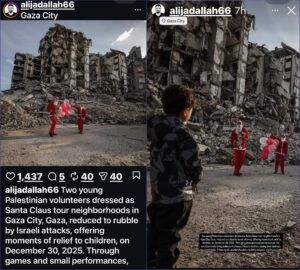
Captions accompanying the photographs repeatedly state that Santas were “bringing joy to children.” Yet across the published frames, children are scarce. Where they do appear, they are isolated, placed deliberately in the foreground, often one or two at a time. There are no crowds, no organic movement, no evidence of a broader children’s gathering.
This is where the construction becomes visible.
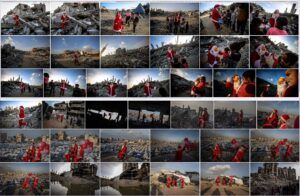
Across multiple frames, the same visual logic repeats. Fixed distances. Similar angles. Identical contrast between vivid red costumes and monochrome destruction. In several images, the same props recur across different locations: a saxophone, identical red-and-white balloons, the same performers repositioned against new backdrops. This repetition functions as a forensic fingerprint of a directed shoot rather than documentation of a spontaneous community event.
The lens is directed away from operational clinics, intact structures, or signs of civilian normality. Surrounding context is excluded to manufacture a total-loss narrative. The result is not fabrication, but something more effective: the omission of alternatives.
View this post on Instagram
The images alone do not capture celebration or community. The captions do that work.
Photographers write captions. Wire services syndicate them globally with minimal scrutiny. Once attached, those words travel intact across platforms, outlets, and continents, shaping interpretation before readers ever examine the frame itself.
This is how curated symbolism becomes news.
Incentives and Distribution
There is a commercial logic underpinning this process. Late December is peak season for “Year in Photos” features, high-traffic galleries, and social amplification. Editors are actively seeking striking visuals that condense complex conflicts into instantly legible symbols.
Images like these are engineered to win that race.
When content produced under Hamas control is distributed via Anadolu and Getty into international wire systems, its origin and intent are softened by scale. In this environment, imagery serves two masters: it humanizes destruction for Western consumption while adhering to a centralized regime of visual control.
Why “Reading” Gaza Imagery Matters
This is not an isolated case. It reflects a pattern documented throughout this series: symbolic staging, selective framing, delayed release, and caption-driven meaning.
The technique used in a high-end portrait studio is the same intellectual framework applied in a conflict zone. The power lies in the omission of the alternative, the editorial decision to present one curated perspective as the singular truth.
These photographs do not lie. They do something more consequential.
They choreograph symbols, time their release, and rely on captions to complete the narrative. They exploit seasonal familiarity to guarantee attention. And they move through global distribution systems that rarely pause to interrogate context.
This is how the Gaza photo factory operates. Not by inventing scenes, but by deciding which realities are allowed to be seen. Until audiences learn to read not just what is shown, but what is carefully kept out of frame, curated imagery will continue to masquerade as unfiltered truth.
Liked this article? Follow HonestReporting on Twitter, Facebook, Instagram and TikTok to see even more posts and videos debunking news bias and smears, as well as other content explaining what’s really going on in Israel and the region. Get updates direct to your phone. Join our WhatsApp and Telegram channels!