Key Takeaways:
- For the past two weeks, Iranians across the country have taken to the streets in sustained protests, openly challenging a regime that has oppressed them since the 1979 Islamic Revolution.
- While mass protests are not new in Iran, the current unrest is fundamentally different, driven by deep-rooted economic collapse, social breakdown, and a growing rejection of the Islamic Republic itself.
- Iranian society is risking arrest and death to demand a future free from Islamic rule, signaling a population that has crossed from protest into resistance.
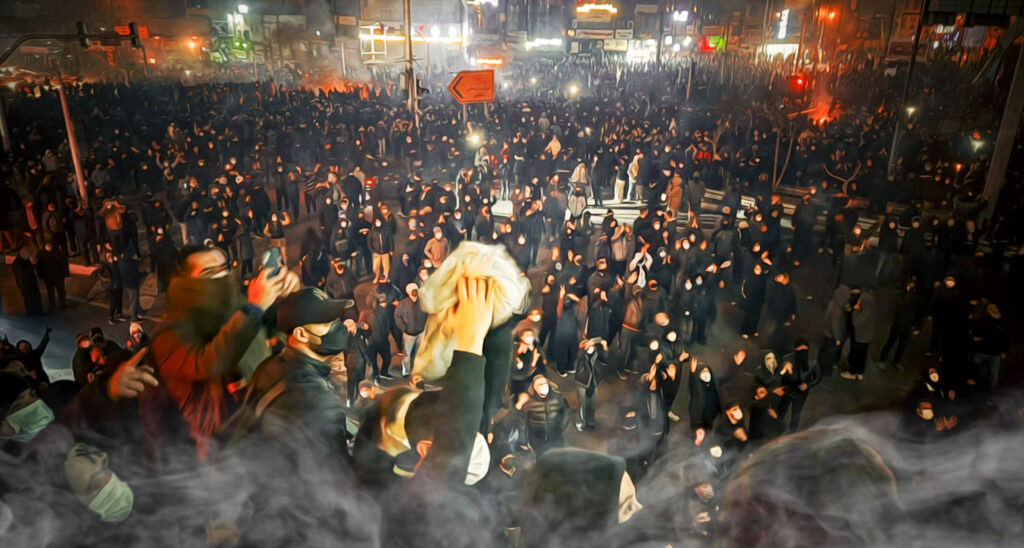
For two weeks straight, the people of Iran have been protesting the regime that has oppressed them since the Islamic Revolution in 1979. Despite internet outages, blackouts, and the risk of being thrown in jail – or worse – ordinary Iranians have taken to the streets to express their opposition to the regime.
View this post on Instagram
Since the Iranian Revolution, mass protests in the country have occurred every several years. Most recently, nationwide protests in 2022 followed the death of Mahsa Amini, who was beaten and arrested by the morality police for not wearing the compulsory hijab correctly. This sparked an outpouring of rage over the death of the young woman.
Today, after a few years of relative quiet, protests are again taking place throughout the country. As Iran expert Behnam Ben Taleblu has explained, the cause of the protests today is not based on a politically charged phenomenon as it was three years ago, but rather “economic shocks, environmental crises, and even social issues.”
The media has widely reported on this as a reaction to the deteriorating Iranian economy, where, on December 28, the Iranian rial plunged to an all-time low against the U.S. dollar. However, as protests erupted and spread rapidly, there is no question that today the protests are more than a simple demonstration against a tanking economy, but rather something much deeper.
Related Reading: How Western Media Are Failing Iranians
Since September 2022, more than 11,000 protests have been recorded in Iran, with over 540 occurring in January 2026 alone. Every day, the streets are filled with brave civilians facing off against members of the Islamic Revolutionary Guard Corps (IRGC), knowing full well that the consequences they face for protesting the regime include being thrown in jail or death. At least 2,600 people have been arrested so far, and 78 killed, though that number is likely much higher, with one source being quoted as seeing as many as 217 protester deaths from January 8 until January 10, coinciding with communication blackouts.
A massacre is unfolding in Iran. The world must act now to prevent further loss of life. pic.twitter.com/1BkdgC7iFx
— Center for Human Rights in Iran (@ICHRI) January 10, 2026
The regime, which is one of the largest sponsors of terrorism in the world, providing millions of dollars each year to its proxy organizations across the Middle East, has begun labeling protesters as “terrorists.” This will likely give the regime all the more reason to arrest demonstrators as an attempt to shut down the protests that seek to topple the regime. The regime has further signaled its willingness to use lethal force as a method to shut down the opposition.
NEW: The Iranian regime has shifted from labeling protesters as “rioters” to describing them as “terrorists,” which signals that the regime has taken an uncompromising stance toward the ongoing protests. The regime will likely use its characterization of protesters as… pic.twitter.com/GJe1BAPAkh
— Institute for the Study of War (@TheStudyofWar) January 11, 2026
Despite the steadiness of the protests, the question remains if this will be enough to finally topple the Iranian regime and bring reform to the country.
Ilan Berman, Iran expert and Vice President of the American Foreign Policy Council, in conversation recently with HonestReporting CEO Jacki Alexander, acknowledged that while the protests are a key factor in regime change, there are currently two missing figures:
- There are currently no inspirational figures who have come out to take charge of the population. Although the opposition is aware of what they do not like in their current leadership, they aren’t necessarily sure about the agenda moving forward.
- There is an organizational problem as the internet continues to be shut down and people are being jailed, resulting in a lack of consistent leadership and forward movement.
Nonetheless, other analysts have acknowledged that many of the conditions necessary to bring regime change – economic challenges, opposition, widespread anger, a narrative of resistance, and a favorable international environment – are beginning to align. A well-performing economy is crucial in any functioning society. The Iranian regime’s inability to control its own economy has spiralled into a greater collapse, which can potentially bring new reforms.
And while he may not be physically present on the ground in Iran, Reza Pahlavi, the heir to the deposed Shah, continues to advocate from abroad, urging Iranians to seize the moment, whether they are monarchists or not.
While we may not know what the future of Iran will look like or whether the protests are enough to bring about regime change, the momentum of the demonstrations is certain to continue. As the regime tightens censorship and repression, the responsibility on the Western world, and specifically the media, grows clearer: Iranian voices must be amplified, not ignored. Silence only strengthens a regime determined to rule by force.
Liked this article? Follow HonestReporting on Twitter, Facebook, Instagram and TikTok to see even more posts and videos debunking news bias and smears, as well as other content explaining what’s really going on in Israel and the region. Get updates direct to your phone. Join our WhatsApp and Telegram channels!
© Divuach Ne’eman R”A, 2025