


Key Takeaways:
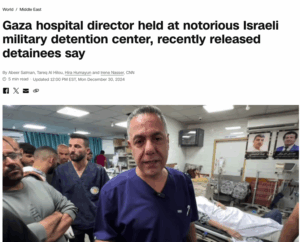
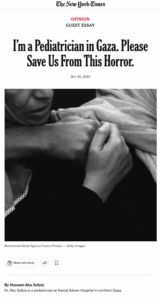
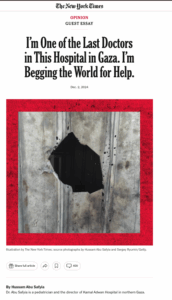
For months, major Western media outlets elevated a Gaza hospital director as a moral authority: a grieving doctor, a humanitarian witness, a voice of conscience amid war. His words were published as op-eds, quoted as testimony, and shared widely as evidence of Israeli brutality. When the IDF detained him and accused him of terrorist activity, petitions circulated demanding his release. Newsrooms framed his arrest as further proof of Israeli wrongdoing.
That narrative has now collapsed.
The media and human rights organizations may have ignored what the IDF was saying about Dr. Hussam Abu Safiya, but the evidence is now irrefutable. NGO Monitor has uncovered a photograph showing the pediatrician and the director of Kamal Adwan hospital in Gaza wearing a Hamas military uniform. That Abu Safiya is a colonel in Hamas is a detail that was never disclosed to readers when his essays were published or when he was presented as a neutral medical professional.
This is not a footnote. It is the central fact.
❗Breaking: NGO Monitor researcher finds photo of Dr. Hussam Abu Safiya in his Hamas uniform. 🧵
That the director of Kamal Adwan Hospital had a Hamas rank was an open secret in Arabic media, yet he was invited to write opeds for the @nytimes and was praised as a hero in an… pic.twitter.com/xPB05nNr2W— NGO Monitor (@NGOmonitor) January 31, 2026
Media Accountability
The question confronting the media is no longer whether Hamas embeds operatives in civilian institutions. That reality is well established. The real issue is how a senior Hamas figure was able to pass through editorial filters and be presented to global audiences as an independent humanitarian voice.
Abu Safiya’s opinion pieces were framed as first-person moral testimony. His political claims were treated as ethical appeals. His detention was widely portrayed as unjust. At no stage were readers informed that he allegedly held a command rank in a U.S.-designated terrorist organization.
That omission cannot be brushed aside.
Watch more: Doctor or Terrorist? The Truth About Gaza’s ‘innocent’ Physician
Either editors were aware of his affiliation and chose not to disclose it, or — far more likely — they failed to conduct basic due diligence before handing him a powerful platform. Neither option reflects well on the standards of journalism these outlets claim to uphold.
Opinion pages are not neutral spaces. When media outlets publish personal testimony during wartime, they implicitly vouch for the credibility and independence of their contributors. Readers are entitled to assume that editors have verified who they are publishing, especially when the contributor comes from a territory ruled by a terrorist organization.
The consequences of failing to do so are serious. These articles shaped public opinion, influenced advocacy campaigns, and were cited in international discourse. When a Hamas colonel is presented as a humanitarian authority, readers are not merely misinformed; they are misled.
This exposure also underscores a broader pattern. Throughout the war, Western media have relied heavily on Gaza-based voices while downplaying or ignoring the coercive environment in which Hamas operates. HonestReporting has repeatedly documented how Hamas embeds itself in hospitals, media institutions, and civilian roles. This case is a textbook example of that strategy succeeding.
This episode also exposes a recurring media failure. When the IDF presents intelligence-based evidence, it is often dismissed as insufficient or “unproven,” yet when independent watchdogs later surface clear, visual proof, many of the same outlets simply ignore it rather than revisit or correct their original reporting.
In any case, now that there is clear evidence, silence is no longer acceptable.
Media outlets that published Abu Safiya’s work or promoted his testimony owe their audiences an explanation. At a minimum, clarifications and transparency are warranted. More importantly, they must explain how such a failure occurred and what safeguards will prevent a repeat.
Accountability does not weaken journalism. It restores trust.
Liked this article? Follow HonestReporting on Twitter, Facebook, Instagram and TikTok to see even more posts and videos debunking news bias and smears, as well as other content explaining what’s really going on in Israel and the region. Get updates direct to your phone. Join our WhatsApp and Telegram channels!