I looked at the date first.
October 7.
Then I looked at the face on The New York Times’ Instagram account.
Saher Alghorra.
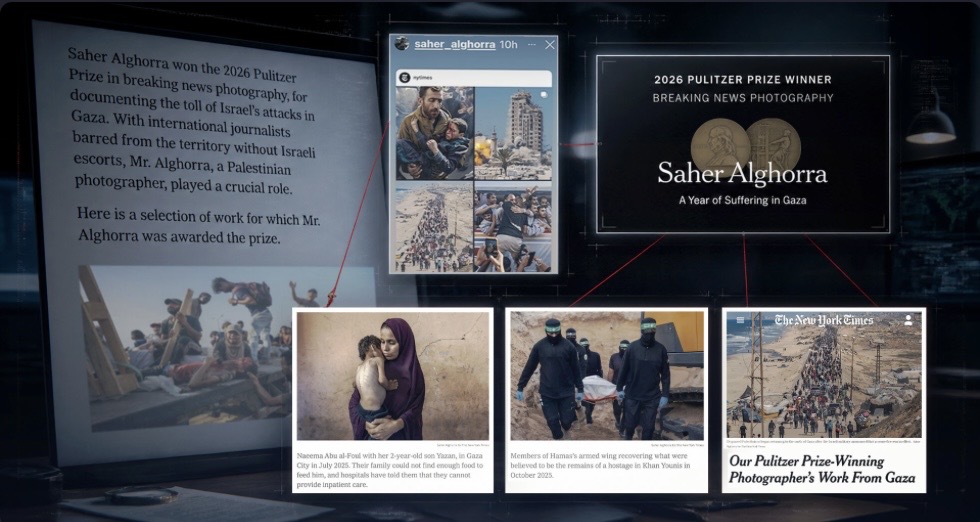
I know his photographs rather well.
Three years to the day after Hamas terrorists murdered some 1,200 people in Israel and dragged 251 hostages into Gaza, The New York Times published a film featuring its Pulitzer Prize-winning Gaza photographer reflecting on the war and the lives of Palestinians rebuilding after it.
The accompanying Instagram text tells readers that Israel and Hamas reached an agreement to end the war nearly a year ago and that Alghorra has documented how people in Gaza are “coping and working to rebuild their lives.”
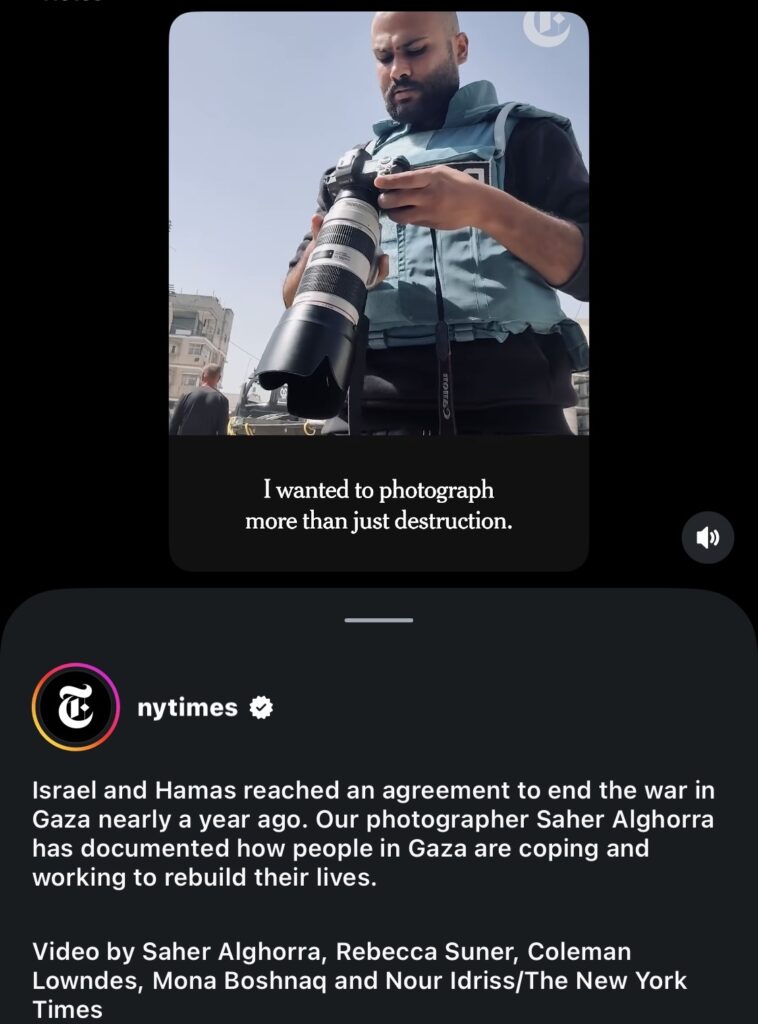
The film is beautifully produced.
That is part of the problem.
Alghorra tells viewers that he wanted to photograph “more than just destruction.” He wanted to show how people were trying to adapt.
We see a wedding. Children. A man making bricks from mud to rebuild a room. People celebrating. People attempting to reconstruct their homes.
Then come the bodies.
Alghorra shows a mass funeral and describes more than 110 Palestinian bodies that he says had been recovered from beneath the rubble. He says it was the largest funeral he had ever seen.
Towards the end, he explains what he wants his photography to do.
For him as a photographer, he says, it is important to show both sides: the enormous contrast between death and Palestinians “rebuilding themselves and their lives.”
There is a legitimate story there.
My question is why The New York Times chose October 7 to tell it.
I Have Been Here With Alghorra Before
Alghorra himself is no stranger to HonestReporting.
Following his award of the 2026 Pulitzer Prize for Breaking News Photography, I raised serious questions about aspects of his winning portfolio, including how certain photographs were obtained, selective framing and the context missing from the images.
There was another Alghorra photograph that deserves to be remembered.
In July 2025, The New York Times prominently featured Alghorra’s photograph of severely emaciated 18-month-old Mohammed Zakaria al-Mutawaq to illustrate starvation in Gaza.
Five days later, the newspaper added an editor’s note acknowledging that the child had pre-existing medical conditions affecting his brain and muscle development.
Now Look at the Date
I don’t need to speculate about Saher Alghorra’s relationship with Hamas.
I don’t know what it is.
I don’t know what arrangements have enabled particular photographs.
Where the evidence ends, so does my claim.
But I know what The New York Times chose to publish.
And I know when it published it.
October 7, 2026.
There were 365 days available for a New York Times film about Gaza rebuilding after the war.
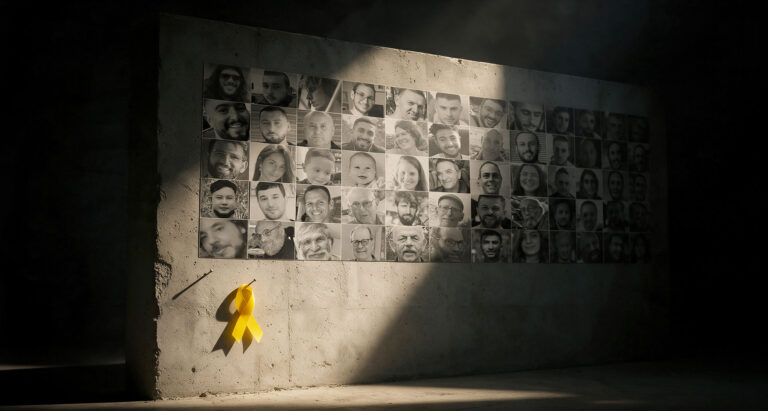
They chose the anniversary of the day Hamas terrorists crossed into Israel, murdered families in their homes, slaughtered young people at a music festival, raped and brutalized victims, and took hostages back into Gaza.
The photographs of that day are burned into Israel’s memory.
Some were taken by Gaza photographers who crossed into Israel during the attack. International news organizations subsequently published their work. HonestReporting has spent three years examining what those photographers witnessed, how they got there, what they photographed, and what happened to those images afterward.
Only the other day, I wrote about those questions in an article on October 7 and photojournalism ethics.
So when The New York Times puts one of its most celebrated Gaza photographers in front of the camera on October 7 and asks its audience to look at Gaza through his eyes, I notice.
Not because Gaza should not be photographed.
I have spent my life believing the opposite.
I notice because newspapers make choices.
Picture editors make choices.
Social media editors make choices.
Someone chose the photographs.
Someone edited the film.
Someone scheduled the post.
And somebody at The New York Times looked at the calendar.
October 7 already has a story.
The New York Times chose another one.
Liked this article? Follow HonestReporting on Twitter, Facebook, Instagram and TikTok to see even more posts and videos debunking news bias and smears, as well as other content explaining what’s really going on in Israel and the region. Get updates direct to your phone. Join our WhatsApp and Telegram channels!
© Divuach Ne’eman R”A, 2025