Key Takeaways
- Qatar has funneled an estimated $100 billion in undocumented money into American universities, and campuses that accepted funds experienced up to 300% more antisemitic incidents than those that did not.
- ISGAP has documented Qatari funding of K–12 curricula used in over 8,000 American schools — materials that erase Israel from the map and strip Jewish and Christian history from the Middle East.
- ISGAP’s research was instrumental in the U.S. government’s designation of the Muslim Brotherhood as a terrorist organization — a move with international ramifications for how Western countries treat Brotherhood-linked institutions and funding.
When Elie Wiesel helped found the Institute for the Study of Global Antisemitism and Policy (ISGAP) in 2003, he told his colleagues they were not living in a time of great urgency. They were living in a time of great emergency.
That was 23 years ago: before October 7th, before the campus encampments; before the new mayor of New York City was a college student at Bowdoin, founding a chapter of Students for Justice in Palestine.
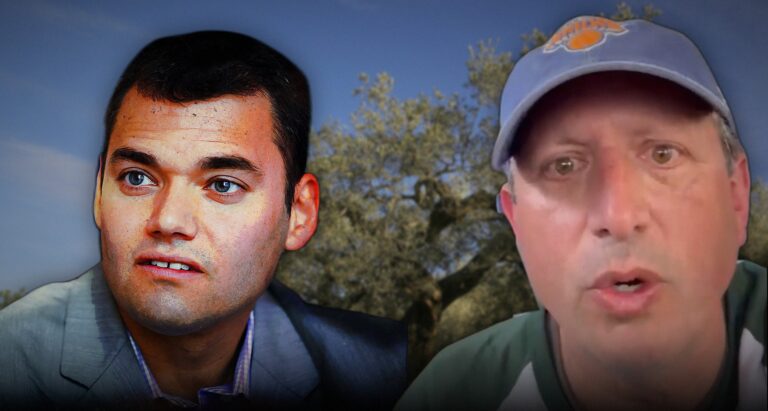
Wiesel saw it coming because he had seen it before. What Dr. Charles Asher Small has spent the last two decades proving is that the emergency did not arrive by accident. It was paid for.
The Late Night That Started Everything
In 2012, Dr. Small was pulling an all-nighter at Stanford, wired after finally finishing a long-overdue book manuscript. Unable to sleep, he was aimlessly browsing the internet when he stumbled across an email from a vice president at Yale University. The administrator’s tone struck him as antisemitic. He Googled him.
What he found was a thread that, once pulled, never stopped unraveling.
The Yale official had worked for a pharmaceutical company in Cambridge, Massachusetts. That company was owned by the Ben Mahfouz family. President Clinton had ordered a military strike on one of their chemical factories in Sudan for supplying weapons to terrorists. From there, Small traced a network of foundations and banks funneling money into Yale and Harvard.
“In about an hour, I found this whole network,” he recalls. “I do social theory and philosophy. I had no idea if what I was finding was real or the tip of an iceberg.”
He gave it to experts in Middle East affairs and terror financing who confirmed: it was indeed the tip of an iceberg.
Following the Money
What began as a late-night internet search grew into one of the most consequential antisemitism research projects in the Western world. Small co-founded ISGAP with Elie Wiesel, and the organization has now published over two dozen reports since October 7th alone, assembling a team of scholars specializing in antisemitism, radical Islam, and forensic accounting.
The numbers they have uncovered are staggering:
- An estimated $100 billion in undocumented foreign funding has flowed into American universities
- $10 billion to Cornell University from Qatar — unreported
- Over $1 billion to Georgetown — unreported
- $1.3 billion to Texas A&M — unreported, with 58 research projects having dual military use and 13 with potential nuclear applications. Texas A&M also handed Qatar all intellectual property rights from 504 research projects
In 2019, ISGAP presented its findings at a Washington summit attended by the Attorney General, the head of the FBI, and Homeland Security leadership. The first Trump administration subsequently launched a federal investigation into illegal foreign funding of American higher education. Within months, investigators found $18 billion in undocumented money. When the Biden administration took office, the investigation was shut down.
The reporting obligations are not new. Laws dating back to the Second World War require universities to disclose any foreign contribution over $250,000 — including the exact amount and the source. Columbia, Harvard, and Yale all failed to comply. Harvard submitted only aggregate totals with no source breakdown. Yale and Columbia cited clerical errors. These were institutions receiving billions of dollars, and not disclosing it as required by law.
Qatar, the Muslim Brotherhood, and a Spiritual Oath
Why would Qatar, a country of 350,000 citizens, invest this kind of money in American academia?
The answer, according to Small, lies in ideology.
Qatar’s royal family holds what Small describes as a spiritual oath to the Muslim Brotherhood, following its religious edicts, rulings, and fatwas. The Muslim Brotherhood, founded roughly 100 years ago in Egypt, is in Small’s framing a fusion of a perversion of Islam with genocidal European antisemitism. Its founding texts drew heavily from The Protocols of the Elders of Zion. The Hamas charter (Hamas being the Palestinian chapter of the Muslim Brotherhood) essentially plagiarizes the Protocols as its constitution.
“The Muslim Brotherhood takes the very words and ideas that led to the Shoah,” Small says. “This is not the military wing or the radical wing. This is core to their ideology.”
The Brotherhood’s strategic goals, articulated 50 years ago, were explicit: create distance between Israel and the United States, weaken and destroy Israel (the “little Satan”), then use antisemitism as a vehicle to fragment and destroy the United States of America (the “great Satan”).
“For 50 years, the Muslim Brotherhood and their proxies have mastered our language, our culture, our systems of governance, our education system,” Small explains. “We in the West perceived them as backwards and primitive. We don’t speak their language. We don’t understand their philosophy. We thought if we were nice to them, everything would be okay.”
Inside the Classroom: How Ideas Filter Down
Georgetown University received over $1 billion from Qatar and serves as, in Small’s description, the most important intellectual hub of Muslim Brotherhood academic activity in the United States. Its diplomatic training program — arguably the most significant in the Western world — is Qatari-funded.
The implications extend well beyond individual institutions. Small traces a direct line between the ideas produced in these environments and the social movements that have erupted in American streets and campuses.
He draws a historical parallel: the great universities of late 19th-century Europe taught racial hierarchy. They defined Jews as a racialized threat to Aryan purity. Those ideas filtered into society, and under the right political and economic conditions, they produced the Holocaust two generations later.
“In the 1970s, 80s, and 90s,” Small explains, “the notion of the Jew shifted completely. Jews were redefined from ‘not white’ into white colonialists, supporters of apartheid, occupiers. Edward Said argued in 1983 that the Palestinians were the Jews and the Israelis were the Nazis. People dismissed him. Maybe he had a bad day, maybe he was a bit disconnected from reality. Those ideas, 40 years later, are the zeitgeist.”
Ten days after October 7th, Small attended a teach-in at Columbia University’s School of Social Work. Professors of literary criticism, philosophy, and gender studies, along with their doctoral students, argued that the massacres were morally justified as part of the resistance, that the violence must continue until the occupation ends, and that anyone who supported Israel must also be resisted by any means. Female professors who identified as feminists defended the rape and torture of Israeli Jewish women as legitimate acts of resistance.
“They were arguing this at the highest levels of scholarship and intellectual discourse,” Small says. “These ideas are dangerous. They filter down from the classroom to the encampment. And now they’re marching through our streets.”
Children in the Crosshairs
The ideological infiltration does not stop at university gates.
ISGAP investigated the Choices Program, a curriculum development initiative based at Brown University’s history department. Funded by Qatar and Muslim Brotherhood-linked entities, the program created educational materials distributed to over 8,000 American schools for students from kindergarten through 12th grade.
In those materials, Israel was erased from the map, and the historical presence of Jews and Christians in the Middle East was removed from the curriculum. When ISGAP published its findings, parents from California to Maine contacted the organization to report that their young children had been receiving antisemitic instruction at school.
Brown University subsequently closed the Choices Program. ISGAP considers it a partial victory. Similar investigations into the manipulation of textbooks and children’s books are ongoing.
The Red-Green Alliance
One of the most disorienting features of the current moment is the coalition that has formed between the radical left and radical Islamist movements — groups diametrically opposed on virtually every social issue except their hostility to Israel and Jewish self-determination.
Small points to philosopher Judith Butler as a representative case. Butler, who is Jewish, queer, and an independent feminist academic, has argued that Hamas and Hezbollah should be understood as part of the global progressive left. Yet these same movements that would punish Butler for leaving her home unaccompanied by a male relative.
“Why would a highly educated, liberated woman want to be associated with social movements that want to subjugate women, murder gay people, kill Jewish people, and destroy democracy?” Small asks.
His answer lies in postmodern anti-colonial philosophy. Thinkers like Foucault viewed the Iranian Revolution as a liberatory event analogous to the French Revolution — a shaking off of Western hegemony. The radical left and radical Islamism share an anti-Western, anti-hegemonic worldview that, in the context of the Israeli-Palestinian conflict, overrides all other considerations. And the irrationality of antisemitism, Small argues, blinds adherents to what should be obvious contradictions.
New York City’s New Mayor
Small is direct about Zohran Mamdani, the new mayor of New York City, who founded Students for Justice in Palestine (SJP) at Bowdoin College as an undergraduate.
“We as a community really need to understand who Mayor Mamdani is,” he says. “The tragedy is that so many Jewish people voted for him. We don’t understand what is threatening our community or our democratic principles.”
SJP emerged from American Muslims for Palestine, a Muslim Brotherhood-affiliated entity. Its goal is not a two-state solution; it is the delegitimization and dismantlement of Israel. Mamdani, Small argues, knows exactly what he is doing.
“He had a Shavuot party. He brings the radical left and a few anti-Zionist religious people together. He looks like a nice guy. But he is delegitimizing and demonizing Israel at every opportunity, and in doing so increasing antisemitism in New York and across the United States in a very dangerous way.”
A Legislative Foothold
ISGAP is currently pushing for passage of the DETERRENT Act, which has cleared the House and is before the Senate. The legislation would lower the reporting threshold for foreign contributions from $250,000 to $50,000 and impose stricter standards on universities accepting money from countries hostile to American democratic values.
The organization also played a significant role in a major recent development: in late 2025, ISGAP published a landmark report on Muslim Brotherhood penetration of the United States. Two weeks after its public launch event in Washington, the American government signed an executive order designating the Muslim Brotherhood as a terrorist organization.
“Eighteen months ago, many people thought it was impossible,” Small says. “How do you ban an entity with no address? How do you ban an entity in a country with the First Amendment? We decided we were going to try anyway. And we decided even if we fail, we’ll create awareness of who the Brotherhood is and what their ideology is.”
The designation is already producing ripple effects in Canada and Western Europe, where governments that might otherwise ignore the issue are paying closer attention.
What Comes Next
ISGAP has major reports forthcoming on Muslim Brotherhood penetration of Canada, on Hezbollah and the IRGC in Canada, on the UK, and on South Africa.
On the broader question of how to fight an ideology, Small is both clear-eyed about the difficulty and genuinely optimistic. Totalitarian communism was defeated. Fascism was defeated. Both required generations of focused resistance.
“Ideas matter and they filter into society. It is a powerful enemy,” he says. “But if we focus and we understand the threat, understand the enemy, understand their ideas, understand what’s hitting us, then we can address the problem, not the symptoms of the problem. We have no choice but to be successful.”
Dr. Charles Asher Small is the founding director of the Institute for the Study of Global Antisemitism and Policy. All ISGAP publications, including the Follow the Money project, are available free at the organization’s website [isgap.org]. This interview was conducted by Ben Chertoff for The Honest Take. Listen and subscribe to the show on your favorite podcast streaming platform. [https://thehonesttake.transistor.fm/episodes/follow-the-money-how-the-muslim-brotherhood-bought-a-seat-in-americas-schools-dr-charles-asher-small]
Liked this article? Follow HonestReporting on Twitter, Facebook, Instagram and TikTok to see even more posts and videos debunking news bias and smears, as well as other content explaining what’s really going on in Israel and the region. Get updates direct to your phone. Join our WhatsApp and Telegram channels!
© Divuach Ne’eman R”A, 2025