



Key Takeaways:
- White phosphorus is widely misunderstood: The substance is not banned under international law and is commonly used by Western militaries, including the United States, the United Kingdom, and NATO forces, primarily to create smoke screens rather than to target people.
- Legality depends on how it is used: Under the Law of Armed Conflict, white phosphorus becomes unlawful only if deliberately used against civilians. When used for smoke, signaling, or illumination during military operations, it remains a lawful battlefield tool.
- Advocacy reports shape media narratives: Allegations originating from organizations like Human Rights Watch can quickly become global headlines before legal or technical context is examined, allowing complex military and legal questions to be simplified into claims of war crimes.
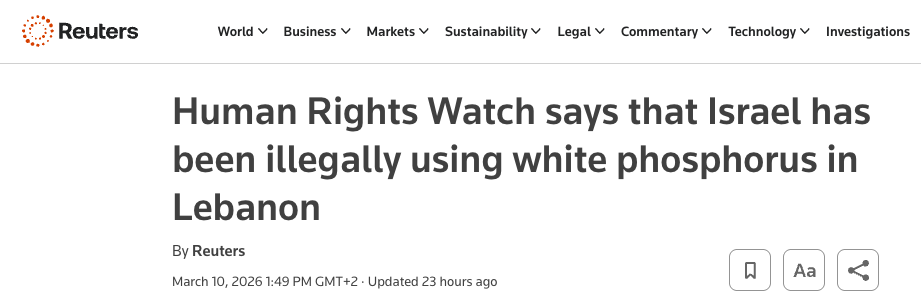
Israel is once again facing accusations that it used white phosphorus during military operations in southern Lebanon. The claim, promoted by Human Rights Watch and quickly amplified by outlets such as Reuters and other international media, has already been framed in the familiar language of alleged war crimes. As often happens in the information war surrounding Israel, the accusation has traveled faster than the legal or military context needed to understand it.
White phosphorus has become a term that instantly triggers outrage. The phrase evokes images of banned weapons and indiscriminate destruction. Yet the reality is far more technical. White phosphorus is not prohibited under international law and is used by many Western militaries, including the United States, the United Kingdom, and NATO forces. Its most common use is not as a weapon against people. Rather, it produces dense smokescreens that obscure troop movements, mark targets, or provide defensive cover during combat operations.
The legal framework is straightforward. White phosphorus becomes unlawful only if it is deliberately used to target civilians. When used to produce smoke during military operations, it remains lawful under the laws of armed conflict. This legal context has been largely absent from reporting surrounding the latest allegations.
Human Rights Watch released a report claiming that Israel used white phosphorus in southern Lebanon in ways that violated international law. Within hours, headlines began circulating suggesting that Israel had once again been caught using a banned or unlawful weapon.
But this framing skips over the central legal question. The key question is how it was used, against whom, and for what purpose.
Law, Evidence, and the Battlefield Reality
Even the evidence cited in the accusations remains highly uncertain. Much of the claim rests on visual interpretation of video footage rather than confirmed battlefield data. Distinguishing between smoke munitions on camera is notoriously difficult. Smoke shells containing white phosphorus can appear visually similar to other smoke shells, making identification from imagery alone unreliable.
The Israel Defense Forces addressed this point directly in their response. The IDF stated that it is currently unaware of and cannot confirm the use of shells containing white phosphorus in Lebanon in the incidents cited by Human Rights Watch.
More importantly, the IDF reiterated the legal framework governing such munitions. Like many Western militaries, Israel possesses smoke shells that contain a limited amount of white phosphorus. These shells are lawful under international law and are primarily used to create smoke screens protecting troops during combat operations. Under IDF directives, such shells are not used to target people or intentionally cause fires.
The military further noted that its procedures restrict the use of such shells in densely populated areas except under specific circumstances, a policy the IDF says exceeds what international law itself requires. In other words, even if smoke shells containing white phosphorus were used, that fact alone would not constitute a violation of international law. The critical question would remain how they were deployed and whether civilians were intentionally targeted.
Military analysts have repeatedly noted that the public debate often ignores these distinctions. Former British Army officer and defense analyst Andrew Fox responded bluntly to accusations circulating online, noting that white phosphorus smoke rounds are legal under international law and widely used by modern militaries. If the substance was used to create a smoke screen rather than as a weapon against civilians, then the allegation of illegality simply does not hold.
Legal scholars have also pointed out that some reporting surrounding these accusations misrepresents the relevant legal frameworks entirely. Dr. Brian L. Cox, an adjunct professor at Cornell Law School and a retired U.S. Army officer specializing in the law of armed conflict, described recent coverage of the issue as “journalistic malpractice.” Responding to a Reuters report citing Human Rights Watch, Cox noted that claims the “use of airburst white phosphorus over populated areas is unlawful” are incorrect under the Law of Armed Conflict.
More #journalisticmalpractice covering int’l law involving armed conflict, this time @Reuters by Pesha Magid (@PMagid, reporting) & Philippa Fletcher (editing).
So much wrong in just news story, but let’s start here:@hrw says under #LOAC “use of airburst white phosphorus over… https://t.co/m5MX0HO8sl pic.twitter.com/mD2zRZCU0X
— Dr. Brian L. Cox (@BrianCox_RLTW) March 11, 2026
Cox explained that journalists often misunderstand the legal status of white phosphorus by incorrectly classifying it as an “incendiary weapon” under Protocol III of the Convention on Certain Conventional Weapons (CCW). In reality, Protocol III defines incendiary weapons as munitions primarily designed to set fire to objects or cause burn injuries. It explicitly excludes munitions whose incendiary effects are incidental, including smoke, illumination, tracers, and signaling systems. White phosphorus smoke rounds fall into this latter category. Their primary purpose is smoke production, not setting fires or burning personnel.
As Cox noted, this distinction is reflected in the U.S. Department of Defense Law of War Manual. As reflected in the U.S. Department of Defense Law of War Manual, incidental incendiary effects do not make white phosphorus a prohibited weapon. Its legality depends on how it is used.
Another important legal detail is often missing from reporting. Israel has not ratified Protocol III of the CCW, meaning the treaty provisions governing air-delivered incendiary weapons do not apply to it as a matter of conventional law. Even if they did, the restrictions would apply specifically to weapons classified as incendiary weapons under the treaty’s definitions. Since white phosphorus smoke munitions are not primarily designed as incendiary weapons, they fall outside that category.
In other words, much of the public debate surrounding white phosphorus rests on a misunderstanding of both the technology and the law governing its use.
Human Rights Watch and the Manufacturing of Accusations
The role of Human Rights Watch in shaping this narrative is also worth examining. The organization presents itself as a neutral monitor of human rights abuses, yet its reports often function as powerful framing devices within the international media ecosystem. Once an allegation appears in a Human Rights Watch report, it is quickly cited by journalists, repeated on social media, and embedded into broader narratives about a conflict. By the time clarifications emerge, the accusation often already carries the weight of accepted fact.
This dynamic is particularly visible in conflicts involving Israel. Complex legal questions about military conduct are frequently reduced to simplified allegations of war crimes. Advocacy organizations issue reports framed around potential violations. Media outlets summarize those reports in headlines that imply wrongdoing. The accusation spreads long before the evidence is rigorously examined.
Human Rights Watch itself has faced growing scrutiny over how its research and reporting are conducted. Former staff member Danielle Haas has spoken publicly about internal dynamics within the organization that raise serious questions about its culture and methodology. According to Haas, ideological assumptions could shape how issues were framed and investigated, creating pressure to produce reports that fit predetermined narratives rather than allowing conclusions to emerge from the evidence.
Critics argue that this dynamic is visible in the white phosphorus controversy itself. As Cox noted in his analysis of the Reuters coverage, stories that begin with the phrase “Human Rights Watch says” and then fail to challenge the organization’s legal claims risk misleading audiences about what international law actually says. When journalists repeat the language of advocacy reports without interrogating the legal assumptions behind them, the result is not reporting but narrative laundering.
The Broader Narrative Battlefield
The controversy surrounding white phosphorus is therefore not simply a legal debate about munitions. It is part of a broader struggle over narrative legitimacy. Modern conflicts are fought not only with rockets and drones but with claims, reports, and competing interpretations of events.
In the case of Israel, this often produces a familiar cycle: a human rights organization issues an allegation, media outlets amplify it, and legal context is simplified or omitted.
White phosphorus illustrates how this dynamic works. A lawful battlefield tool becomes, through repetition and framing, a symbol of alleged criminality. The technical details governing its lawful use disappear, replaced by the emotionally charged image of a supposedly banned weapon.
The reality is far less sensational. White phosphorus smoke shells are used by militaries around the world. Their legality depends entirely on how they are used. If deployed to create smoke screens that protect troops or civilians during combat operations, they fall squarely within the framework of lawful military conduct.
That basic fact has not stopped the accusations from spreading. In the information war surrounding Israel, it rarely does.
Liked this article? Follow HonestReporting on Twitter, Facebook, Instagram and TikTok to see even more posts and videos debunking news bias and smears, as well as other content explaining what’s really going on in Israel and the region. Get updates direct to your phone. Join our WhatsApp and Telegram channels!