Key Takeaways:
-
The New York Times amplified an antisemitic trope by promoting a clip suggesting Jewish or Israeli influence secretly controls U.S. policy.
-
The remark went unchallenged, with the Times offering no context about the long history of such conspiratorial narratives.
-
Instead of scrutinizing the claim, the paper highlighted it, raising serious questions about editorial judgment and responsibility.
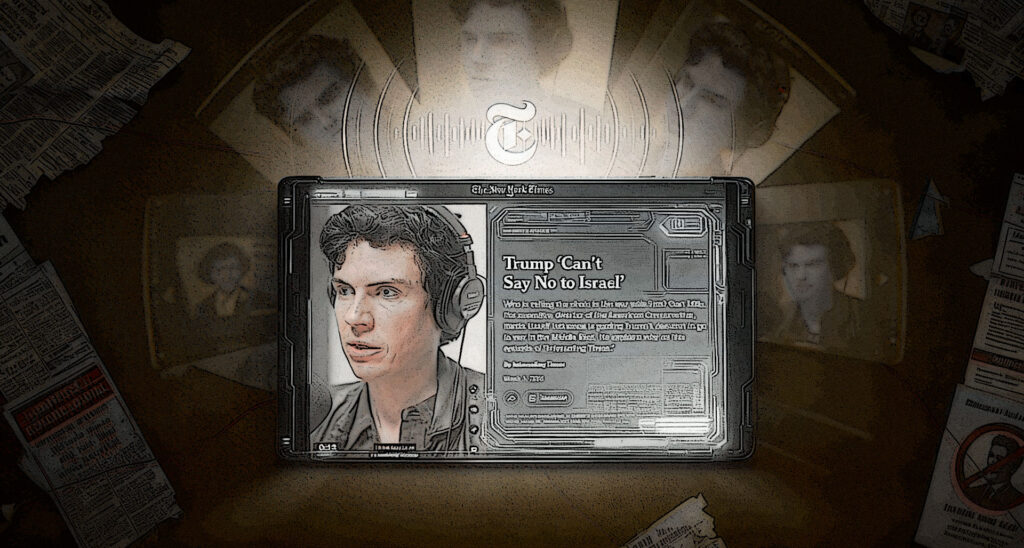
The New York Times recently published an opinion interview with Curt Mills, executive director of The American Conservative, discussing U.S. foreign policy and the relationship between Washington and Israel. On its face, the format is familiar: a newspaper interviews a commentator with strong views, and readers are invited to consider the argument.
But near the end of the conversation, the interview veers into territory that should have set off alarm bells in any newsroom.
During the exchange, Mills suggests that American policy toward Israel is shaped by political pressure in Washington in a way that echoes a well-known antisemitic trope. The claim does not resemble conventional policy analysis. Instead, it implies — without evidence — that Jewish or pro-Israel influence operates behind the scenes to shape U.S. decision-making.
This narrative will be familiar to anyone who has studied antisemitism. It closely resembles the narrative popularized by “The Protocols of the Elders of Zion,” the notorious forgery that claimed Jewish leaders secretly controlled world affairs. The document has been used for generations to justify hatred and violence toward Jews.
The interview with the executive director of the American Conservative is nearly an hour long.
The New York Times chose 55 seconds of tropes to promote it.
“I think they’re an intimidating society. And I think people are afraid of Mossad. I think people are afraid of Israeli… pic.twitter.com/drkFQs5U0Q
— HonestReporting (@HonestReporting) March 9, 2026
I think they’re an intimidating society, and I think people are afraid of Mossad. I think people are afraid of Israeli influence in foreign policy. They’re afraid of what it can do to people’s careers.
A serious newspaper should immediately recognize the lineage of such claims. Or at the very least, call them out as unsupported.
Yet, The New York Times did not challenge the framing in the interview. Nor did it provide readers with context about the history of the trope. Instead, the paper went a step further. The very same segment — lifted from an hour-long conversation — was highlighted in a promotional clip used to advertise the interview.
In other words, a remark that echoes one of the most enduring antisemitic conspiracy narratives was not only published but actively promoted.
That choice raises obvious questions about editorial judgment. Who decided this was the clip to highlight? And why?
It appears that The New York Times had no problem amplifying antisemitic insinuations if they could generate attention.
There is also the issue of transparency. Mills is not a neutral foreign policy analyst. He is a political activist and the executive director of a publication associated with a specific ideological current in American politics. In the interview, he speaks from that perspective. Yet readers are given little insight into the extent of his ideological positioning or his broader political views.
At a certain point in the interview, he even suggests that Tucker Carlson — a media personality who has faced repeated accusations of antisemitic rhetoric and ties to terror-supporting Qatar — may be America’s next president.
That context matters. When newspapers present commentators as analysts of international affairs, transparency about their political commitments is part of responsible journalism.
The problem is not that the Times interviewed Mills. Newspapers should host debate and challenge conventional thinking. The problem is that the interview allowed antisemitic insinuations to pass without scrutiny and then amplified them through promotional material.
Editorial oversight exists for precisely these moments.
In this case, The New York Times did not merely report the remark. It gave it a megaphone.
That is not fearless journalism. It is a failure of judgment.
Liked this article? Follow HonestReporting on Twitter, Facebook, Instagram and TikTok to see even more posts and videos debunking news bias and smears, as well as other content explaining what’s really going on in Israel and the region. Get updates direct to your phone. Join our WhatsApp and Telegram channels!
© Divuach Ne’eman R”A, 2025