Key Takeaways:
- UN Special Rapporteur Francesca Albanese’s report alleged that a “mediacide” was unfolding, due to the IDF supposedly targeting Gazan journalists, Israeli media inciting violence, and international media toeing to Israeli narratives.
- The report selectively references incidents, ignoring all information that contradicts the “mediacide” narrative, even when contradicted by the source material.
- Albanese launders allegations by activist groups and propaganda outlets, presenting them as UN work, hypocritically engaging in the same regurgitation of information she accuses others of.
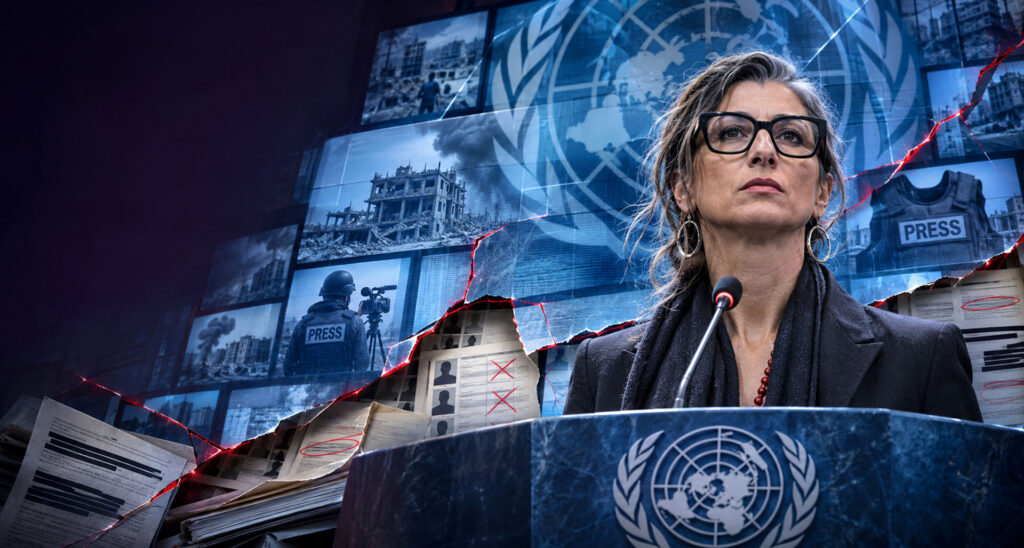
UN Special Rapporteur Francesca Albanese’s October 25 report engages in selective evidence, hypocrisy, and unprofessional conflations to advance a predetermined narrative that Israel has deliberately targeted Gazan journalists and media infrastructure.
Her report supposedly details how truth is being destroyed as part of a genocidal act in Gaza, which she describes as “mediacide.” Not only does Albanese allege that the Israeli military has a policy of “silencing the witnesses” in Gaza, but also that Israeli media is complicit in genocide through incitement, and international media has adopted Israeli narratives and rhetoric.
Albanese repeatedly makes dramatic allegations, detailing smaller cherry-picked issues that are insinuated to be connected solely through juxtaposition. Any act or consequence that impacts the subject is inevitably by Israeli design and representative of a broader trend. Evidence to the contrary, even published by sources she otherwise regularly cites, has been ignored in the report. The chief among such unsubstantiated claims is her overarching framing that “Israel has systematically sought to silence Palestinian journalism to obscure its oppression of the Palestinian people and avoid accountability.”
Ignoring Terrorists’ Own Admissions About Journalists
The UN rapporteur claimed that since the October 7 Massacre, almost 300 journalists were killed in the war, with almost 70 ostensibly for their work and the others in “indiscriminate” attacks. Aside from the fact that allegations of indiscriminate attacks would be contradictory to claims of a targeted campaign against the journalists, the UN report did not present any new research on the matter, but instead laundered older unverifiable UN claims. The figure cited by Albanese was rounded up from the number produced by the office of UNHCR commissioner Volker Türk. Türk’s office has not published data on this claim for verification, and the figure far exceeds the highest count in any open database, with the Palestinian Journalists Syndicate (PJS) recording only 262. Albanese does cite PJS eight times, though it is a partisan Fatah organization whose leadership endorses and supports terrorism and terrorists.
The report claims that Israel justified the death of many of these supposed Gazan journalists by branding them combatants, further indicating that any such allegations were nothing but systematically manufactured smears. Albanese appeared to ignore the volumes of evidence that show that terrorists have been widely passed off as journalists. Open-source intelligence collection has shown how family members have eulogized them as Mujahid fighters, such as Al-Sahel Media journalist Yasser Abu Namous, whose wife posted a video of him in military uniform and whose sister called him an Izz ad-Din al-Qassam Brigades fighter. Terrorist organizations have published dozens of martyr posters detailing the membership and military role of supposed journalists within their organizations. This included Palestinian Islamic Jihad (PIJ) operative and Al-Elamya News Agency photographer Ahmed Abu Skheil, who was killed in the same airstrike as his father, senior Al-Quds Brigade officer Mohammed Abu Skheil, and his sister, freelance journalist Zahraa Abu Skheil.
Not only did Albanese ignore the admissions of terrorist groups and the families of terrorists, but she also selectively ignored the non-governmental organizations (NGOs) that she cited regularly throughout the report. With a September 24 audit, the Committee to Protect Journalists (CPJ), an NGO cited 22 times in the Albanese report, removed 22 media workers from their slain Gazan journalist database for being combatants or non-journalists. This was in addition to the 11 that had been previously removed. An HonestReporting audit found that their database is still half composed of individuals with terrorism ties. By September, the International Federation of Journalists removed several names from their list of media workers, many of which were also removed from the CPJ database. Reporters Without Borders removed five terrorists from its database by October. IFJ and RSF were cited four and three times in the report, respectively. Despite multiple citations of these organizations, Albanese did not note their removal of combatants from amongst alleged journalists.
As evidence for Albanese’s claim that the IDF deliberately targeted media workers, the report cited the August 25, 2025 Nasser Hospital strike, claiming that it was an example of a double tap strike tactic to murder journalists. While Albanese dismissed IDF claims that troops believed that they were targeting a Hamas camera, she didn’t acknowledge that two Hamas terrorists and one Palestinian Islamic Jihad terrorist were killed in the incident. Another incident that Albanese cited in her report was the April 8, 2026 drone strike that killed Mohammed Washah. The IDF has produced photographs of Washah armed and with Hamas personnel.
Albanese’s argument that there was an Israeli policy to “silence Palestinian journalism” is also based on destruction of telecommunications infrastructure, but the UN rapporteur provides scant proof of such a policy. Instead, only wartime consequences that impact journalists were presented, leaving the reader to make the connection themselves. This included the recounting of 150 journalists’ homes being destroyed as a signal of “intent to persecute the media sector.” Albanese’s lazy research cites a secondary source – a Palestinian Centre for Human Rights (PCHR) report which references a PJS report. Yet there is no indication beyond the figures that the several dozen homes among the thousands of buildings destroyed in the war were singled out. There is more evidence that terrorists were targeted in the incidents, as among the homes listed by PJS was the residence of Hamas terrorist Mohammed Abu Matar. Side effects of battle with Hamas impacting journalism are repeatedly presented by Albanese as intentional and systematic, such as the Palestine Tower strike, which she characterizes as “on the first day of the current assault, 7 October, 2023.” The tower reportedly held press offices, as highlighted by Albanese, but at the time the IDF stated that they had targeted Hamas assets within the tower, and had given occupants evacuation warnings.
Exaggerating the Extent of Incitement
Israeli journalists who do report the integration of Hamas infrastructure into civilian objects or of terrorists posing as media workers, which Albanese ignored, are slammed in her report as engaging in incitement. While Albanese ignored the violent issues that plague Palestinian media apparatus, she accused its Israeli counterpart of complicity in a supposed genocide, and called for investigations of Israeli media figures by the International Criminal Court (ICC).
Albanese presented several incidents that occurred on one TV news outlet, Channel 14, as representative of Israeli media at large. The outlet has almost half the viewership of Channel 12, and is by no means reflective of the entire landscape. The UN representative’s report even hints at this exaggeration by extolling Haaretz, an Israeli newspaper, for coverage critical of the war effort.
Even controversial remarks made on Channel 14 were often made by guests or by commentators on social media. On the evening of October 7, Shimon Riklin wrote on his personal X account that “Gaza should be wiped off the face of the earth,” and Eyal Golan is a singer rather than a journalist. Yet Albanese used them as examples of a channel-wide issue.
When a commentator was suspended by Channel 12 for stating that Palestinian terrorism suspects should be sodomized, rather than accountability being taken by one outlet being highlighted, the report turned it into a story about Channel 14 rehiring him. Albanese also ignored the other accountability measures taken by Israeli outlets. On Channel 14, when a guest called for indiscriminate attacks on Gaza even if it killed civilians or hostages, the host pushed back and Israeli commentators rejected the remarks. Yet only one side of the equation is presented in the report.
While Albanese decries alleged incitement to genocide in Israeli media, which has been the subject of petitions to the Supreme Court, she dismissed legal action against Palestinian news outlets for incitement to terrorism as dubious. Yet there has been no shortage of Palestinian journalists calling for violence during the war. Reuters freelancer Mohammed Fayq Abu Mostafa shared calls to invade Israel on October 7. Another freelancer, Doaa Rouqa, praised the attacks as glorious. An account allegedly controlled by Motaz Azaiza called Jews “donkeys” in the wake of the attacks.
Israeli media was further castigated by Albanese for ostensibly “delegitimizing” claims by Hamas and activists about famine and genocide. She asserted that outlets were echoing Israeli government claims, while at the same time demanding that they not challenge allegations made by the United Nations, even just by publishing an op-ed. She demanded censorship of those critical of her narrative by describing it as “denial,” which in turn was genocide complicity that had to be investigated. Challenges of UN figures by the media may be warranted when officials like Albanese have spread false information, such as about casualty statistics in Gaza.
Concurrently, Albanese decried the military censorship regime in Israel, which prevents the publication of security issues. This can include matters like the location of an Iron Dome battery or revealing the identity of a fallen soldier before their family had been notified. Albanese characterized military concerns as illegitimate, only used to exert control, and called on the UN General Assembly to rescind “censorship measures, outlet bans and media-restrictive legislation.” She also echoed assertions of journalists having to engage in a “Faustian bargain” with the Israeli government, and report from afar or accept Israeli control. Yet while Albanese only devoted a line to Hamas intimidation and control, the Gaza media landscape is far more restrictive. Not only do terrorist organizations control many outlets, but journalists are expected to follow strict measures. Freedom House 2026 rates Israel 73/100, or “Free”, with 3/4 for media. Gaza has 2/100 with 0/4 for media, as Hamas is “actively suppressing criticism.”
International Media Supposedly is Pro-Israel
It is not just Israeli media that Albanese attacked – she also accused international media of cleaving to the Israeli narrative. At the behest of Israel and pressure groups, Western news outlets and social media companies allegedly legitimized Israel’s actions by repeating its claims and sidelining Palestinian voices. The UN rapporteur said that this was evidenced by the BBC style guide noting that the Israeli government supposedly prefers to refer to the West Bank and such as disputed territories, and that unrecognized outposts are distinct from official settlements. She also chastised the New York Times for advising caution in internal memos when using terms such as “genocide” and “ethnic cleansing.”
Albanese claimed that those who didn’t meet such standards and chose to represent the Palestinian position were suppressed. She referred to BBC Arabic journalists being disciplined, but didn’t detail that the six journalists were taken off air over posts likening Hamas to freedom fighters and calling October 7 a “morning of hope.” Instead, the information was obfuscated by citing another UN report rather than primary sources. Albanese also referenced the censorship of documentaries. One of the films Albanese framed as censored, Gaza: Doctors Under Attack, aired on Channel 4 and went on to win a BAFTA. In the other case, the BBC documentary Gaza: How to Survive a Warzone was ruled by OFCOM as being “materially misleading” for concealing that its narrator was the son of Hamas’ deputy agriculture minister.
Albanese left out the evidence that the BBC’s coverage tilted in the opposite direction of what she claimed. The Asserson report reviewed four months of BBC output and found Israel associated with genocide 283 times compared to 19 times for Hamas, logging 1,553 breaches of the broadcaster’s own guidelines. The leaked Prescott memo to the BBC Board found that BBC Arabic aired a contributor who had called for Jews to be burned “as Hitler did” 244 times in 18 months, and ran none of 19 English-language hostage stories between May and October 2024. Instead, Albanese claimed “more than 100 documented instances” of BBC presenters dismissing genocide claims from a study by the Centre for Media Monitoring, a project of the Muslim Council of Britain. The BBC disputed both studies, but Albanese selectively presented only one side’s advocacy research as fact.
The New York Times’s leaked memo, as described by The Intercept, did not read as a pro-Israel screed as Albanese depicted it, but as a flawed attempt to seek balance and nuance. NYT itself slammed her allegations that the outlet had been compelled by outside sources to provide pro-Israel coverage, telling The Times of Israel that she had no proof. While Albanese detailed in her report that the Gray Lady had ignored Israeli strikes within Gaza safe zones, neglected to cover allegations of sexual assault against Palestinians, and downplayed Israeli responsibility in violence, the NYT said that the opposite was true. NYT had reportedly scrutinized the humanitarian zones and whether they were safe, and charged that Albanese had ignored their investigation of sexual assault claims. Further, the UN Rapporteur had no proof, said the NYT, of the outlet downplaying Israeli actions. The report was “not impartial, nor are the sources she relies on,” NYT told The Times of Israel.
Albanese’s Hypocrisy
Indeed, much of the report, which features little original analysis or research, relies on propaganda outlets such as 972 Mag, Jacobin, or Drop Site News. Albanese’s breakdown of headlines was conducted by a little-known Artificial Intelligence-driven activist organization. Albanese’s report laundered older accusations by such activists and presented them with the UN brand.
The UN rapporteur also accused Western outlets of running Israeli claims “without verification,” noting news outlets’ references to Hamas’ use of human shields, hospitals as bases, and infiltration of UNRWA. Yet these elements have been corroborated multiple times. The U.S. intelligence community assessed with high confidence that Hamas and PIJ used Al-Shifa Hospital and tunnels beneath it for command activity and to hold hostages. The UN’s own internal investigators found that nine UNRWA staff may have been involved in October 7, and UNRWA fired them. Where an Israeli claim did fall apart, such as the “beheaded babies” report, the result of mistaken coverage during the early fog of war, outlets corrected it within days.
Meanwhile Albanese omitted the war’s most glaring verification failures, nearly all of which ran against Israel. The New York Times admitted that its early coverage of the Al-Ahli hospital incident relied too heavily on unverifiable Hamas claims, and later added an editor’s note to a front-page starvation photo after learning the child had pre-existing conditions. A Free Press investigation found at least a dozen other viral “starvation” images whose subjects had serious underlying illnesses. NYT also published poorly sourced claims about dogs being trained to rape Palestinian captives. While Albanese castigated outlets for uncritically echoing narratives and information, like Western outlets, she routinely ran the Hamas-run health ministry’s casualty totals with little examination or qualification. Not only did Albanese use the Hamas health ministry’s casualty data as an untarnished fact, but she has also cited inflated figures advanced by activists. In May 2025, she urged the media to stop attributing Gaza casualty figures to the Hamas-run ministry.
The hypocrisy of uncritically adopting information that confirmed her priors was characteristic of the entire report. Albanese’s “mediacide” report is less an investigation than an exercise in confirmation: it rests on figures no independent database supports, and it leaves out the evidence that would complicate its story, from the martyr posters naming “journalists” as fighters to the removals of combatants by the press freedom groups she cites. She emphasizes one Israeli channel’s issues as the whole of Israeli press and accuses Western outlets of pro-Israel bias, while ignoring Palestinian journalists who celebrated October 7 and the media’s far worse failures in relaying Hamas claims. A report that calls for investigating journalists over their coverage of UN information as “denial” does not defend press freedom; it undermines the credibility of the UN mandate it represents. The report is not an investigation; it is legitimization of pre-existing propaganda using the UN name.
Liked this article? Follow HonestReporting on Twitter, Facebook, Instagram and TikTok to see even more posts and videos debunking news bias and smears, as well as other content explaining what’s really going on in Israel and the region. Get updates direct to your phone. Join our WhatsApp and Telegram channels!
© Divuach Ne’eman R”A, 2025