Key Takeaways:
- A mainstream political platform treated open Hamas apologetics as a debate over tone and messaging rather than drawing a clear moral line against terrorism.
- Hasan Piker framed Zionism as fascism, tokenized fringe Jewish voices, and promoted rhetoric that demonizes Jewish self-determination while insisting he opposes antisemitism.
- Jon Favreau’s “grey zone” framing allowed two non-Jews to position themselves as arbiters of what should count as sensible Jewish concern, helping normalize anti-Jewish narratives as legitimate discourse.
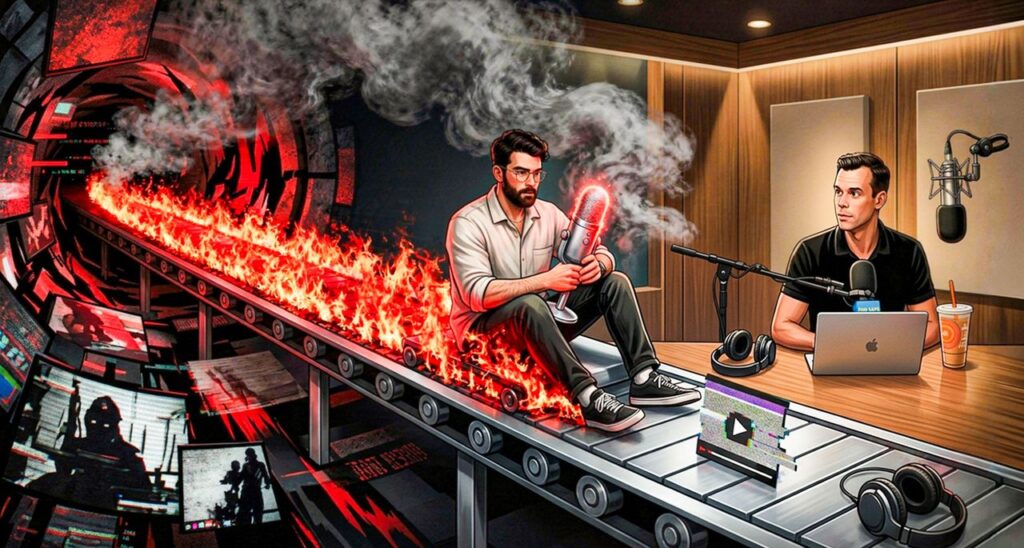
The recent exchange between Jon Favreau and Hasan Piker on the Pod Save America podcast was revealing not simply because of what was said, but because of how it was treated. What should have been a clear moral confrontation over support for a terrorist movement instead became, at points, a conversation about rhetoric, presentation, and political strategy. That shift matters because it shows how openly extremist ideas have been absorbed into mainstream commentary.
Piker openly defended his statement that Hamas is “a thousand times better” than Israel, said he would “vote for Hamas,” and framed October 7 as the reaction of an oppressed people after decades of alleged Israeli “ethnic cleansing,” “apartheid,” and “subjugation.” He described the massacre as “unbelievably violent,” yet even that wording functioned more as a factual description than a moral condemnation. The brutality was acknowledged, but the legitimacy of the attack as resistance was left standing.
That distinction is critical. One can describe an atrocity as horrific while still excusing it. Saying an event was violent is not the same as saying it was wrong. In Piker’s framing, October 7 was tragic perhaps, excessive perhaps, but fundamentally understandable. The burden of blame shifted away from those who planned and carried out the massacre and back onto Israel itself.
Favreau even asked Piker whether he felt a responsibility to choose his words more carefully or at least in ways less likely to be misconstrued. That moment was revealing. It suggested the problem was not praise for Hamas itself, but the branding of that praise. The issue was reframed from moral substance to communications strategy.
When Pushback Misses the Point
Favreau did challenge Piker in places, but much of the pushback operated on the level of tactics rather than principle. He argued that October 7 had been catastrophic for Palestinians and that violent resistance movements are often less successful. Whatever the intention, that framework was itself revealing. The central issue with October 7 was not whether it was politically effective. It was that Jews were hunted, tortured, raped, burned alive, kidnapped, and murdered because they were Jews.
Yet even criticism of Hamas often displaced Israelis from the moral center of the story. Jewish victims became secondary to a discussion about Palestinian political outcomes. The massacre was analyzed less as evil than as a failed strategy.
At moments, the conversation appeared to drift from challenge into coaching. Rather than drawing a hard moral line, it risked implying that Piker’s real mistake was messaging. Instead of defending Hamas so openly, he should simply emphasize “what Israel has done.” In effect, the problem became not the justification of terror, but the bluntness of the justification.
This is how radical ideas are laundered into respectable discourse. Raw apologetics for violence are translated into the language of grievance, anti-colonial theory, structural oppression, and communications discipline. The substance remains. Only the packaging changes.
Delegitimizing Jewish Self-Determination
At 40:25-43:06, Favreau asked whether Piker opposed the idea of a Jewish state or merely the policies of Israel. Piker’s answer was direct: Zionism, he said, is “a fascist ideology.”
That statement should have ended any ambiguity. Zionism is the national liberation movement of the Jewish people, the belief that Jews, like other peoples, have the right to self-determination in their ancestral homeland. To call that fascism is not criticism of policy. It is demonization of Jewish collective existence.
Favreau attempted to soften the issue by distinguishing between Jews who simply support a homeland and those who insist Israel remain a Jewish-majority state, implying the latter position is morally suspect or anti-democratic. But this misses the basic reality of nationhood. Israel being a Jewish-majority state is precisely how Jewish self-determination functions democratically. Remove that principle, and what remains is not a reformed Jewish homeland but the dismantling of one.
Both men then appeared to agree that something akin to this demographic struggle is what is unfolding now. Again, the framing was extraordinary: Jewish sovereignty was treated as the problem, rather than the repeated movements dedicated to destroying it.
In the same segment, Piker invoked Albert Einstein, claiming that Einstein believed early Jewish defense forces were like Nazis, and made clear that he shared the comparison. The implication was unmistakable: Israel is Nazi-like, Jews have become what once persecuted them. It was a textbook example of Holocaust inversion, and it passed without meaningful pushback.
Tokenization and Blaming Jews for Anti-Jewish Hatred
At 43:08-43:50, Piker cited Ofer Cassif and other fringe Jewish voices who validate his worldview while disregarding the overwhelming majority of Jews who reject it.
This is a familiar tactic. Find the smallest number of Jews who agree with anti-Jewish narratives, elevate them as authentic moral witnesses, and use them against the Jewish mainstream. It is tokenization masquerading as nuance.
From 44:53 onward, the conversation moved into the now familiar “grey zone” discussion. Favreau suggested that most sensible people believe anti-Zionism is not automatically antisemitism, while portraying Piker as someone who merely crosses lines at times. There was something remarkable in that exchange: two non-Jews positioning themselves as arbiters of what should count as sensible Jewish concern, effectively dictating to the Jewish community where the boundaries of antisemitism begin and end.
But there is no serious grey zone in the record. Piker has referred to ultra-Orthodox Jews as inbred, called liberal Zionists liberal Nazis, and used openly dehumanizing slurs such as “pigdogs.”
He repeatedly insists that he hates antisemitism. Yet hatred does not cease to be hatred because it is wrapped in activist language. He is not combating anti-Jewish hostility. He is manufacturing and mainstreaming it.
He also advanced another classic inversion: blaming Jews and Israel for antisemitism itself. According to this logic, anti-Jewish hatred rises because of Israel’s actions or because Jewish institutions identify with Israel. He accused Israel of tying itself to Judaism “in a sinister way,” and claimed Jewish organizations such as the Anti-Defamation League merely masquerade as Jewish while functioning as pro-Israel fronts. Who is he to instruct Jews how to define their own institutions, loyalties, identities, or communal boundaries?
Favreau came close to recognizing the mechanism when he noted that some people merge hatred of Israel with hatred of Jews and then with older forms of antisemitism. But that is not an accidental overlap. It is the point. Israel is so easily demonized in many circles precisely because it is treated as the collective Jew.
What Was Really Normalized
What made the exchange so disturbing was not only Piker’s rhetoric. It was the normalization of a worldview in which Jewish victims are backgrounded, anti-Jewish violence is contextualized into legitimacy, terror movements are romanticized, Jewish self-determination is framed as uniquely suspect, fringe Jews are weaponized against the mainstream, and antisemitism is blamed on Jews themselves.
That this happened on a major mainstream platform should concern anyone who still believes extremism arrives only in crude or explicit forms. Often, it arrives smiling, polished, fluent, and introduced as a legitimate side of the debate.
October 7 was not resistance. It was anti-Jewish barbarism. Any discourse that cannot begin there has already abandoned moral seriousness.
Shame on them both.
Liked this article? Follow HonestReporting on Twitter, Facebook, Instagram and TikTok to see even more posts and videos debunking news bias and smears, as well as other content explaining what’s really going on in Israel and the region. Get updates direct to your phone. Join our WhatsApp and Telegram channels!
© Divuach Ne’eman R”A, 2025

Ben M. Freeman
Founder of the modern Jewish Pride movement, Ben M. Freeman is the author of Jewish Pride: Rebuilding a People (2021) Reclaiming our Story: The Pursuit of Jewish Pride (2022) and The Jews: An Indigenous People (2025). Educating, inspiring and empowering, his work focuses on Jewish identity and historical and contemporary Jew-hatred. A Holocaust scholar for over fifteen years, Ben came to prominence during the Corbyn Labour Jew-hate crisis in the UK and quickly became one of his generation’s leading Jewish thinkers and voices against Jew-hate.