Key Takeaways:
- On the same day, AP and France24 published pieces implying that Israel is deliberately targeting children in its war against Hezbollah in Lebanon.
- Both outlets warp Lebanese casualty figures, omitting the IDF’s statistics, to present a disproportionate number of children being targeted. Neither outlet acknowledges that the child they focus on has family ties to Hezbollah.
- When context is left out, the media is no longer reporting on the unfortunate civilian casualties with impartiality, but is crafting a narrative about Israel’s war.
Individual tragedies can be devastating. But when they are elevated into symbols of a broader reality, they can also distort it.
From reading Associated Press (AP) and France24 alone, readers could easily be led to believe that Israel is deliberately targeting children in Lebanon.
On April 15, both outlets published stories centered on the death of a Lebanese child. Neither explicitly makes the accusation. But both strongly imply it.
That implication is serious. It also demands scrutiny.
1/
They won’t say it outright, but both @AP and @France24_en are pushing a narrative that Israel targets Lebanese children.Two reports, same day, same victim.
That’s not coincidence. ? pic.twitter.com/5DKaAoh2Fb
— HonestReporting (@HonestReporting) April 16, 2026
Casualty Numbers in Lebanon
Hezbollah has long embedded its terrorist infrastructure within southern Lebanon’s civilian population, turning villages into military strongholds.
This reality makes civilian casualties tragically inevitable even as the IDF takes steps to minimize harm.
But the available data tells a very different story from the one implied by AP and France24.
2/
Let’s be clear: the death of 168 Lebanese children is tragic.But unlike Hezbollah, which deliberately targets Israeli civilians, the IDF does not target children.
And the numbers matter.
Children make up ~26% of Lebanon’s population.
Yet, even by reported figures, they… pic.twitter.com/YCWNNQLLhW— HonestReporting (@HonestReporting) April 16, 2026
On April 10, the IDF stated that it had killed over 1,400 Hezbollah operatives, a figure that later exceeded 1,700. Lebanese authorities, meanwhile, reported approximately 1,800 total deaths.
Even taking these figures at face value, children account for roughly 8% of fatalities, despite under-15s making up around 26% of Lebanon’s population.
That disparity matters.
It suggests that Israel is not targeting children, but Hezbollah operatives, despite the group’s systematic use of civilian infrastructure.
The resulting civilian-to-combatant ratio – approximately 1:3.5 – is strikingly low for urban warfare. It may in fact be lower still, given that 15-18 year olds, who are theoretically of fighting age, are often counted as children in casualty statistics.
Yet headlines such as France24’s “168 children killed” and AP’s “Children killed in Lebanon” foreground children as the primary victims, shaping perception without properly contextualizing the data.
Tragedy is real. But tragedy alone is not analysis.
The Missing Context Behind One Child’s Death
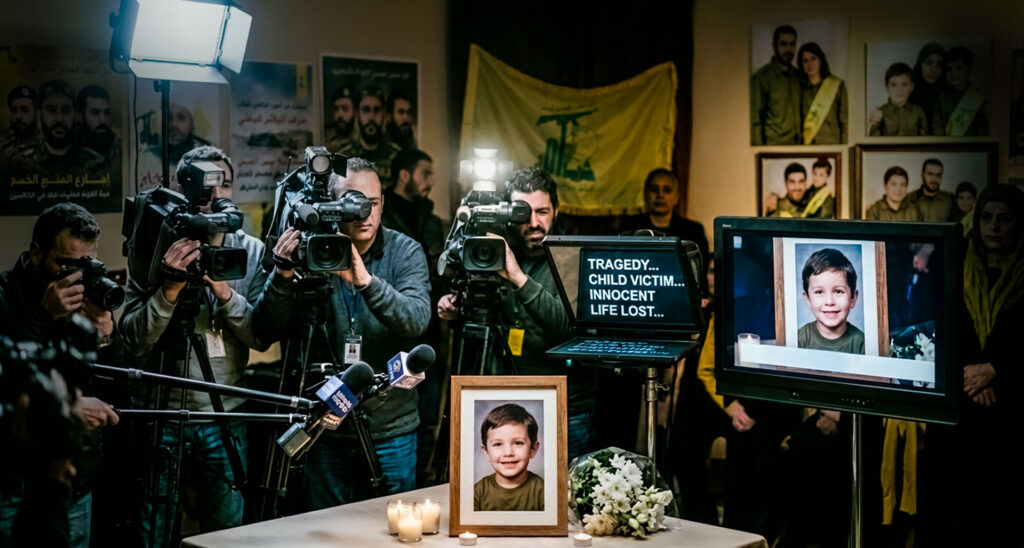
Both outlets anchor their reporting around the death of 11-year-old Jawad Younes, presenting his story as emblematic.
But crucial context is missing.
The incident occurred on March 28 – more than two weeks before both reports were published. And while a BBC report noted Jawad’s admiration for “the idea of martyrdom” and his desire to “be with the resistance” when he grew up, AP chose to highlight only his aspiration to become an engineer.
That omission matters, not because it justifies his death, but because it reveals the environment in which he lived.
5/
Jawad reportedly “wanted to be with the resistance” — i.e. Hezbollah.That alone doesn’t make him a target.
But it tells you something about the environment.More crucially, his uncle’s body was draped in a Hezbollah flag.
That strongly suggests a Hezbollah presence at the… pic.twitter.com/wdFnbHMt4V
— HonestReporting (@HonestReporting) April 16, 2026
Further context is even more telling.
Jawad was reportedly killed alongside his uncle. At their funeral, one coffin was draped in a Hezbollah flag, strongly indicating that his uncle was a member of the terrorist organization.
This is not incidental. It points directly to Hezbollah’s practice of embedding operatives within civilian settings, turning those environments into legitimate military targets under international law.
So why omit these details?
Why revisit this story weeks later, stripped of key context?
The answer appears to lie not in informing readers, but in reinforcing a narrative.
Platforming Doctor Ghassan Abu-Sittah
Both AP and France24 also rely on Dr. Ghassan Abu-Sittah as a source.
This, too, raises serious questions.
Abu-Sittah has previously been exposed by HonestReporting. In November 2023, he promoted conspiracy theories about Israeli use of white phosphorus while denying Hamas activity in hospitals. In March 2025, he openly praised Hamas as “the resistance.”
6/
Both AP and France24 platform “surgeon” Dr. Ghassan Abu Sittah.But here’s the context they won’t give you:
Abu Sittah has been exposed as a terrorist sympathizer — yet his incendiary rhetoric is rarely challenged, investigated, or even questioned by a compliant media.…
— HonestReporting (@HonestReporting) April 16, 2026
Yet in both reports, he is presented without challenge or context.
That is not neutral sourcing. It is selective amplification.
The human cost of war is undeniable. Innocent lives are lost. Civilian suffering is real.
But when coverage strips away context, when data is framed selectively, when key details are omitted, and when partisan voices are platformed without scrutiny, what remains is not journalism.
It is narrative construction carefully designed to impact readers emotionally, rather than reflect reality.
AP and France24 published near-identical stories, on the same day, centered on the same case.
That is not coincidence. It is convergence. And the result is a deeply misleading portrayal of a complex and tragic reality.
Liked this article? Follow HonestReporting on Twitter, Facebook, Instagram and TikTok to see even more posts and videos debunking news bias and smears, as well as other content explaining what’s really going on in Israel and the region. Get updates direct to your phone. Join our WhatsApp and Telegram channels!
© Divuach Ne’eman R”A, 2025