Key Takeaways:
- “Chosen People” is routinely distorted into a claim of Jewish supremacy when it actually denotes obligation, not privilege.
- Judaism’s concept of chosenness is rooted in covenant – binding Jews to ethical responsibility, accountability, and moral conduct, not superiority.
- Recasting Jewish chosenness as racial ideology inverts reality, weaponizing theology to falsely accuse Jews of the very worldview they reject.
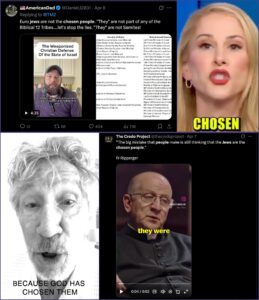
From Ana Kasparian’s claim that Israelis are despised worldwide for “thinking you’re G-d’s chosen people” to Roger Waters’ unhinged assertion that Israelis seek to first take over the Middle East and then “rule the world for the rest of eternity,” because they see themselves as the “chosen people” and everyone else as “non-human,” you have likely come across similar screeds on social media.
Few phrases in Judaism have been so persistently misrepresented as “the Chosen People.”
It is routinely weaponized against Jews and Israel, invoked as supposed proof of Jewish supremacism or racial hierarchy. In this telling, Jewish identity is reduced to a claim of inherent superiority, in direct contradiction to the Bible’s core teaching that all humans are created in God’s image.
This distortion is not accidental. It reflects a broader tendency to force Jewish history and theology into categories that do not fit, particularly a modern racial lens that is both historically and conceptually misplaced.
That lens becomes especially grotesque when applied in the shadow of the Holocaust, which is itself often misappropriated in contemporary discourse. The accusation is inverted: the victims of a racial ideology are recast as its inheritors, with “chosenness” presented as evidence of exclusion, purity, or dominance.
First, this argument ignores a basic reality: Jews are not a race. Jewish communities span continents and cultures, from Ethiopian to Indian to European and Middle Eastern, bound not by racial homogeneity but by shared history, law, and tradition.
More fundamentally, it misunderstands the meaning of the term itself.
So what does it actually mean to be “chosen”?
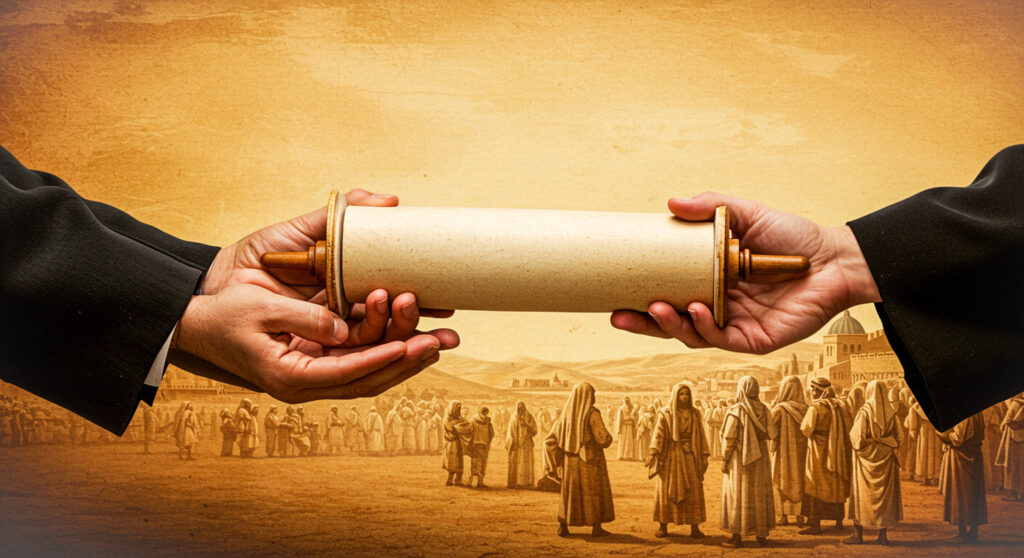
The concept originates in the Torah, most explicitly in Exodus 19:6, at Mount Sinai, where the Israelites are described as a “holy nation” and enter into covenant with God through the giving of the Ten Commandments. It is reiterated in Deuteronomy 7:6, where they are called a “treasured people.”
But “chosen” in this context does not denote privilege in the modern sense. It denotes obligation.
It is a designation tied to covenant, a binding commitment to a specific set of laws, ethical demands, and responsibilities. Far from elevating Jews above others, it imposes a burden: to live according to a demanding moral and religious framework, and to serve as a model of ethical conduct.
The idea reaches back to Abraham in Genesis and to the emergence of the Israelites. In Jewish tradition, Abraham is the figure who recognizes one God and rejects the pagan world around him. That matters because the ancient Near East was overwhelmingly polytheistic. Egyptians worshipped a vast pantheon of gods with different powers and domains; Mesopotamian religion centered on multiple deities embodied in cult statues housed and served in temples, and the Greeks likewise appealed to different gods for different realms of life and nature.
In Jewish tradition, Abraham is the first great monotheist, the figure who recognizes one God in a world dominated by idol worship. That belief becomes the foundation of Jewish faith and practice, expressed most clearly in the central declaration of God’s oneness that underpins Jewish prayer.
The God Abraham recognizes is not a local or limited deity, but the Creator of everything: heaven and earth, day and night, and all living things. That idea alone marked a radical break from the religious norms of the ancient world.
Abraham is also understood to have paid a price for that belief. He rejected the idols of his time, broke with the society around him, and left his homeland in response to God’s command, entering into a life defined by faith and uncertainty.
And this is the crucial point often missed. The biblical story is not one of a people passively selected as superior, but of a family, and later a nation, entering into a binding relationship with one God and accepting the obligations that come with it.
That obligation has had consequences far beyond the Jewish people themselves. Two of the world’s largest faiths, Christianity and Islam, emerge from this tradition. Both are rooted in the idea of one God and draw directly on core elements of the Hebrew Bible. The concept of ethical monotheism, first articulated in Jewish tradition, did not remain confined to one people. It reshaped the religious landscape of much of the world.
“Chosenness,” then, is not an abstract or inward-looking idea. Its influence has been global.
In the Bible, the relationship between God and humanity is not static. It is dynamic, and at times contested. God is not presented as distant or arbitrary, but as a being with whom humans can argue, plead, and reason.
We see this most clearly in the story of the destruction of Sodom and Gomorrah, where Abraham challenges God’s initial judgment, pressing the case that the innocent should not be destroyed alongside the guilty. The episode is striking not because Abraham “wins,” by reducing the threshold to ten righteous individuals, but because he argues at all. It establishes a model of moral engagement, not passive submission.
Elsewhere, the Bible repeatedly shows that covenant comes with conditions. The Israelites are not portrayed as unconditionally elevated, but as accountable. In the story of the spies, their lack of faith leads to a generation being barred from entering the Promised Land. Even Moses is not exempt from consequence.
The message is consistent. “Chosen” does not mean guaranteed. It means bound by responsibilities. In a modern context, that responsibility includes building a just society, resisting oppression, and protecting the vulnerable; to honor human dignity in law, economics, and war; to safeguard creation rather than exploit it; and to pursue truth and integrity in public life, even when it is costly.
Nor is this covenant entirely closed. The Hebrew Bible recognizes righteous individuals outside the Jewish people, and Jewish law has long held that converts are fully part of the nation, with no lesser status. Entry into the covenant is not racial, but defined by commitment.
The phrase “Chosen People” has become a rhetorical weapon, deployed to accuse Jews of the very worldview their tradition rejects.
A covenant of obligation is recast as a claim of superiority. A system built on law, restraint, and accountability is twisted into something racial and exclusionary.
But the distortion does not hold. “Chosen” in Judaism does not mean elevated. It means obligated.
And the refusal to understand that is not an intellectual failure. It is a choice.
Liked this article? Follow HonestReporting on Twitter, Facebook, Instagram and TikTok to see even more posts and videos debunking news bias and smears, as well as other content explaining what’s really going on in Israel and the region. Get updates direct to your phone. Join our WhatsApp and Telegram channels!
© Divuach Ne’eman R”A, 2025