Key Takeaways:
- Since January 2026, outlets ran 984 stories on “settler violence” in the West Bank against only 9 articles on Palestinian attacks on Jewish civilians in the same territory, resulting in a 109:1 disparity.
- International coverage peaked in June 2026, the same month official Israeli data displayed attacks decreased 25% from March, meaning coverage volume moved in the opposite direction of the trend it was reporting on.
- Palestinian livelihood is an established media narrative, whereas Jewish livelihood in the same window is barely a frame at all, appearing almost exclusively to cast “violent settlers” as the cause of someone else’s harm.
Every week, major news outlets worldwide publish stories around the purportedly most tense area of the Israeli-Palestinian conflict: the West Bank, also known as Judea and Samaria.
From international coverage alone, a glaringly lopsided picture is painted. One in which Jewish civilians living, or even merely visiting, anywhere in the West Bank are vigilantes, acting with impunity and attacking Palestinians.
There is already a misleading narrative about “settler violence,” one built on casualty statistics that blur terrorists with civilians. But a deeper issue has now become apparent, whereby “settler violence” itself has become a permanent framework through which stories about and from the West Bank are told, independent of actual trends and attempts to curb the violence.
Coverage of Attacks
There is no doubt that there are violent attacks, conducted by both Jewish Israelis and Palestinians in the West Bank. But the extent to which the attacks are covered and used to build a broader narrative tells a larger story about how journalists selectively choose what to report on.
HonestReporting.ai Labs ran an analysis on 77 outlets with coverage of “settler violence” or “settler attacks” in the West Bank between January 1, 2026 and July 20, 2026. The same search was then done for the inverse of attacks – Palestinian terrorism on Israelis in the same window.
During the period examined, international outlets published 984 stories about “settler violence” in the West Bank. Over the same timeframe, the audit identified just nine genuine articles covering Palestinian attacks on Israelis in the West Bank, resulting in a 109:1 coverage disparity. Such a disparity inevitably shapes public understanding of the conflict, creating the impression that violence is coming only from one direction.
The coverage of “settler violence” in the West Bank nearly tripled from 71 stories in January to 235 in June, when coverage peaked. During the Israel-Iran war in March 2026, coverage saw its first peak, with 187 stories.
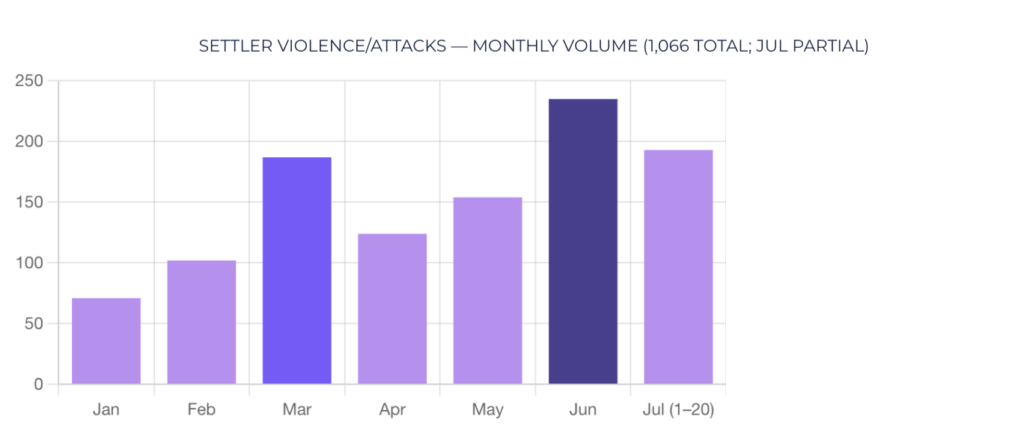
At the same time as the coverage increased in March, the Israeli government quietly began to curb violence by Jewish civilians in the West Bank. The result was that by mid-July, violence had decreased 25% in comparison to March. Yet despite the analysis being tracked only through July 20, the coverage was greater than in March, driven in large part due to Congressman Ro Khanna’s inconsistent claims that he was “detained” by “Israeli settlers” alongside the IDF.
The peaks thus are not a reflection of violence itself, further demonstrating how a narrative can dominate the news cycle, independent of facts.
Reality vs Coverage
Violence, by any perpetrator, should be condemned and reported proportionately. When journalists only focus on one side of the story, reality starts to slip away.
According to a report by Rescuers Without Borders (Hatzalah Judea and Samaria), since January 2026, through July 16, 2026, 140 Jewish civilians were injured in the West Bank region and one person was killed. In total, 441 incidents, including arson, stone throwing, and physical assault, were recorded. Shortly after the publication of the report, another two Israelis were murdered on July 24, and several other incidents of violence against Israelis were recorded.
These acts of violence seldom make it to the front page of the international media, distorting the reality and the real threat of terrorism coming from the West Bank.
Agrarian Events Shape Coverage
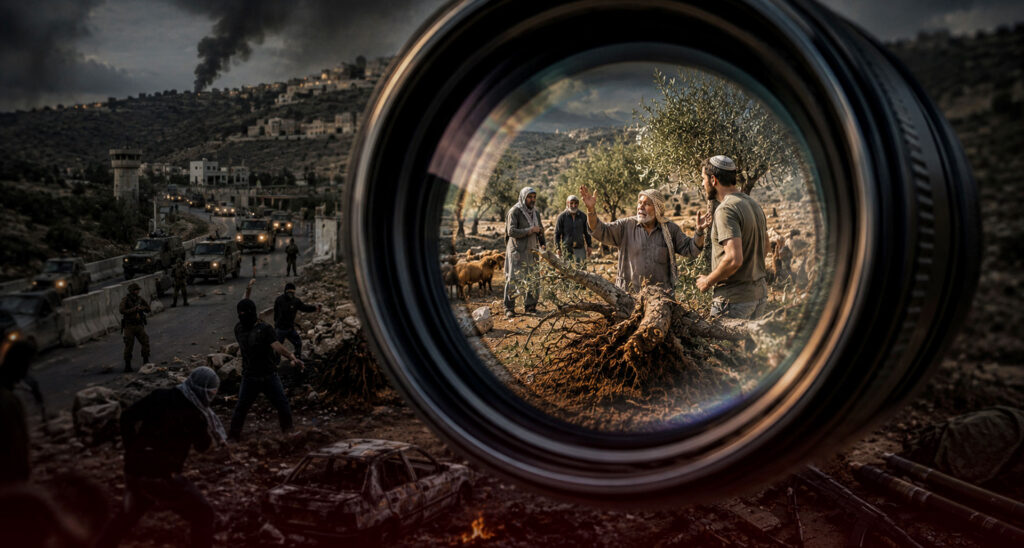
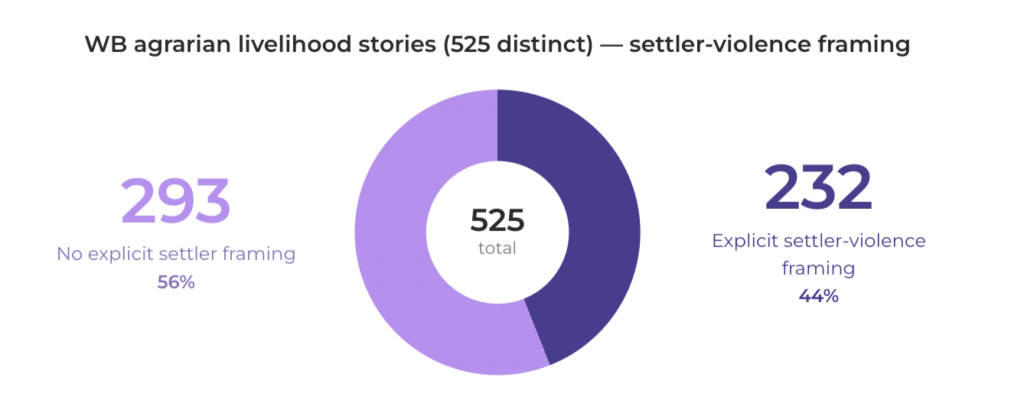
The “settler violence” also works tandemly with stories on Palestinian livelihood in the West Bank. 525 articles about the West Bank include agrarian livelihood framing, referring to olive groves, livestock, grazing, and farmers or farmland. Of that, roughly 73% mention “settlers” and 44% explicitly use the “settler violence” or “settler attacks” framing.
Contrarily, the same search for stories on Jewish livelihood in the West Bank brought up effectively no results. The limited 116 stories of Jewish livelihood almost entirely cast the “settler” framing as the aggressor or the structural problem, inverting the story to maintain the framework set up in the Palestinian agrarian narrative.
Jewish livelihood is not only never established as a lens to understand the conflict through, but it is further used as a tool to demonize Jewish people living in the West Bank – no matter that the vast majority do not engage in violence. When Jewish agricultural stories appear, it is only to be understood as the cause of harm to Palestinian livelihood.
When a Label Becomes an Identity
A single label has absorbed an entire population into one undifferentiated threat. The term “settler” is no longer used to describe the location of someone’s home, but the very person they are. The “settler” framework has evolved beyond a label, morphing into an editorial framing that impacts which attacks are covered, whose suffering is highlighted, how livelihoods are portrayed, and even how ordinary civilians are identified and dehumanized.
Related Reading: From Civilian to “Settler”: Inside the Media’s Reframing of Israelis
When a disproportionate focus on one group of people becomes the defining lens through which an entire conflict is understood, journalism begins to diverge from the reality it claims to be reporting. The outcome isn’t only a skewed count of stories. It’s a framework sturdy enough to keep producing the same verdict even as the facts change.
Liked this article? Follow HonestReporting on Twitter, Facebook, Instagram and TikTok to see even more posts and videos debunking news bias and smears, as well as other content explaining what’s really going on in Israel and the region. Get updates direct to your phone. Join our WhatsApp and Telegram channels!
© Divuach Ne’eman R”A, 2025