


Key Takeaways:
- Following the October 7 terrorist attacks, the IDF increased its presence in the West Bank, fearing that communities there would face a similar style of attack.
- As part of the IDF’s Judea and Samaria Division, many reserve soldiers joined “Hagmar” or regional defense units to protect local communities.
- The Guardian has collectively described these civil defense units and soldiers who serve in them as “vigilante militias,” relying on anti-Israel sources such as Breaking the Silence to do so.
There is no denying the terrorist threat in the West Bank. While there has been a decrease in terrorist attacks in the West Bank over the past two years – 847 terror attacks in 2023, compared to 504 attacks in 2024, and only 57 in 2025 – this is in large part attributed to the IDF’s counterterrorism measures.
These measures have increased in the wake of October 7, due to the fear of a similar style attack occurring in the West Bank. This fear is not unfounded. Immediately following Hamas’ attack, the terror leaders called on Palestinians in the West Bank to similarly take up arms against Israelis.
Related Reading: The Missing Context: Media Distort the West Bank Terror Threat
It is for the concern of terror attacks against Israeli civilians that the IDF increased its presence in the West Bank, including through Hagmar or regional defense units that fall under the Judea and Samaria Division of the Central Command. These units, incorporated into the framework of the Civil Defense after the Yom Kippur War, were established to protect agricultural communities along the borders. Hagmar are primarily composed of local residents who can respond rapidly to emergencies, a necessity in a small country facing persistent security threats.
The need for such units is vital. Nonetheless, that need has gone entirely overlooked by much of the Western media. In “Settler-only IDF units functioning as ‘vigilante militias’ in West Bank,” The Guardian has attempted to subvert the need for Hagmar, diluting and incorrectly applying a sweeping label of “vigilante militias” to describe these reservist soldiers.
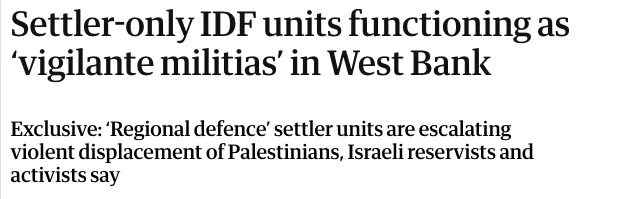
While it is important to acknowledge that there have been minimal incidents of violence perpetrated against Palestinians in the West Bank by reserve soldiers, to frame the issue as being reflective of the whole is entirely inaccurate. When such incidents occur, the IDF takes disciplinary action, including removing the soldier from duty. Nevertheless, The Guardian frames the issue as one that is far larger than reported to persuade its readers that the purpose of Hagmar is not to protect local Jewish communities, but to attack and intimidate Palestinians – an assertion unsupported by evidence.
Agenda-Driven Sources and Questionable Conclusions
The sources The Guardian relies on come from two previous reserve soldiers who served in the West Bank. However, none of the quoted individuals actually served in Hagmar. Thus, their claims are not based on personal experience in a unit they deemed problematic, but instead are based on speculation and hearsay. If at least 7,000 reservists were mobilized to Hagmar at the beginning of the war, as The Guardian reports, then its quoting of two soldiers who never served in that unit is, at best, misleading, or at worst, willfully misrepresentative.
More concerning still is The Guardian’s reliance on overtly anti-Israel organizations such as Breaking the Silence. The organization has, on multiple occasions, used fabricated or exaggerated evidence to make sweeping accusations against the Jewish state, such as claiming that the IDF uses Palestinians as human shields.
0/10 for original journalism, @CNN. Only in the past 10 days, both @nytimes & @guardian have published almost identical stories accusing the IDF of using Palestinians as human shields.
So what’s the connection & what’s the problem? 🧵https://t.co/6pn3uLbGOk
— HonestReporting (@HonestReporting) October 24, 2024
Breaking the Silence’s executive director, Nadav Weiman, characterized Hagmar as “settler militias driven by a violent, zero-sum ideology,” while co-founder Yehuda Shaul asserted that “the settlers are the IDF, and the IDF are settlers,” advancing a political narrative rather than a factual analysis that acknowledges real security concerns. Presenting activists with a clear agenda as authoritative voices not only misleads readers and reinforces a distorted portrayal of the IDF, but it does so hypocritically, as the article itself rests on an unsubstantiated claim that soldiers in Hagmar are driven by an ideological agenda, rather than a security necessity.
One anonymous reserve soldier who did not serve in Hagmar but served in the West Bank was provided by Breaking the Silence, claiming that an irregular dress code amplified the “vigilante feel” of Hagmar. The sole evidence offered to support this claim is a video provided by the International Solidarity Movement (ISM), an organization that has previously expressed support for and aided terrorism. The footage shows a single reservist putting on his military shirt and vest while already partially dressed in uniform – hardly evidence of lawlessness or vigilantism.
While the video is framed as a “gotcha” moment, it instead underscores the security reality facing Israeli reservists across the country, who adapt to their environment and remain prepared to respond to threats and security concerns. This would be especially true for the soldier in the video who was previously the target of a terror attack.
The Guardian uses a single soldier already dressed in uniform to imply that all reservists not in uniform are vigilantes. Yet, in Israel, it is commonplace for reserve soldiers to be in civilian clothing while lawfully carrying a firearm. Moreover, Israel’s gun laws are among the strictest in the world, meaning that armed civilians and reservists are subject to rigorous licensing, oversight, and accountability, thus undermining this broader suggestion that Israelis seen without a military uniform equates to vigilantism.
Legitimate scrutiny over military conduct is essential in ensuring the army is adhering to its own guidelines. But such scrutiny also requires firsthand evidence and proportional analysis, not anonymous testimonies by soldiers without experience in such units, quotes from activists, and selective visuals that attempt to tell a story rather than establish facts.
In blurring the distinction between isolated incidents and institutional policy, and by substituting ideological advocacy for verifiable facts, The Guardian does not illuminate the situation on the ground – it obscures it.
Liked this article? Follow HonestReporting on Twitter, Facebook, Instagram and TikTok to see even more posts and videos debunking news bias and smears, as well as other content explaining what’s really going on in Israel and the region. Get updates direct to your phone. Join our WhatsApp and Telegram channels!