Key Takeaways:
- CNN obscures Hamas’ links to key sources, including Gaza’s Health Ministry and Civil Defense.
- Controversies surrounding Euro-Med Monitor and Medical Aid for Palestinians go unmentioned.
- CNN presents a contested UN genocide inquiry without acknowledging serious criticisms of its findings.
CNN’s problem with its Gaza coverage goes beyond biased language or story selection. It is the network’s willingness to rely on Hamas-run institutions, individuals accused of Hamas membership, and controversial human rights organizations without giving readers the context needed to assess their credibility.
In an October 12 report titled “Buried bodies, cleared rubble, Israel’s yellow line: How war is hampering the search for Gaza’s missing,” CNN examines the plight of Palestinians unable to recover the remains of relatives buried beneath the rubble.
There is nothing objectionable about reporting on their suffering. But journalists have an obligation to scrutinize their sources, particularly in territory governed by a terrorist organization with a powerful propaganda apparatus. In CNN’s report, that scrutiny is conspicuously absent.
When Hamas Disappears From the Source Attribution
CNN reports that more than 74,000 people have been killed in Gaza, attributing the figure to the “Palestinian Ministry of Health.”
It neglects to mention that this is the Hamas-run Gaza Health Ministry, operating under the authority of the terrorist organization that seized control of the territory in 2007. Nor does CNN explain that its casualty figures do not distinguish between civilians and combatants, an essential distinction when assessing the human cost of the war.
CNN similarly cites Gaza’s Civil Defense estimate of approximately 8,000 people missing beneath the rubble and quotes its spokesman, Mahmoud Basal, on the difficulties of recovering bodies.
Again, vital context is missing. Gaza’s Civil Defense operates within the Hamas-run governmental structure. And in June 2025, the Israel Defense Forces released documents recovered in Gaza that it said identified Basal as a member of Hamas’ military wing, specifically its Zeitoun Battalion.
CNN presents him simply as a Civil Defense spokesman, with no indication of his alleged Hamas affiliation.
HonestReporting has previously highlighted the allegations against Basal and challenged outlets, including CNN, over their continued reliance on him. The issue is hardly obscure or new.
The Convenient Credibility of a “Geneva-Based NGO”
CNN’s sourcing problems extend beyond Hamas-controlled institutions.
In discussing Israeli efforts to clear rubble in areas under military control, CNN cites Euro-Med Human Rights Monitor, describing it simply as a “Geneva-based NGO.”
That description sounds reassuringly independent and professional. Unfortunately, it tells readers almost nothing about the organization’s deeply problematic record.
As HonestReporting has previously documented, Euro-Med’s founder and chairman, Ramy Abdu, and former chairman Mazen Kahel appeared on a 2013 Israeli list identifying Hamas operatives and institutions in Europe.
The organization has also repeatedly promoted inflammatory and inadequately substantiated allegations against Israel, including claims of Israeli organ trafficking, executions inside Al-Shifa Hospital, and babies allegedly found bound with zip ties in mass graves.
Euro-Med was also a significant source behind Nicholas Kristof’s notorious New York Times column featuring allegations that Israeli forces had used dogs to sexually assault Palestinian detainees, claims whose sourcing and inconsistencies have been challenged extensively.
This is not the record of an organization that deserves automatic credibility simply because it has an office in Geneva and describes itself as a human rights monitor.
Yet that is effectively how CNN presents it.
The report offers no meaningful examination of Euro-Med’s leadership, its alleged Hamas connections, or its history of circulating sensational accusations against Israel. Readers are instead given a geographical location and an NGO label, both of which help confer an air of legitimacy without addressing the organization’s credibility.
Medical Aid for Palestinians: Another NGO With a Troubling Record
CNN also quotes Israa Alqahwaji, the Gaza mental health program coordinator for the British charity Medical Aid for Palestinians (MAP), without acknowledging the organization’s controversial history.
In 2014, MAP founder and honorary patron Dr. Swee Ang circulated an antisemitic video by former Ku Klux Klan leader David Duke alleging Jewish control of the media, banking and politics. In 2018, MAP faced a formal complaint alleging anti-Jewish hatred and links to PFLP affiliates. MAP denied the allegations, and the Charity Commission closed the case without opening an inquiry.
More recently, NGO Monitor cited a 2022 internal Hamas document identifying a purported MAP administrator in Gaza as affiliated with Hamas. MAP disputes the allegation, saying it has no such position and that its checks found no employees linked to armed groups.
None of this implicates Alqahwaji personally or invalidates her observations. But it does raise questions about CNN’s willingness to present MAP as an uncontroversial humanitarian organization without disclosing its troubled history.
A UN Inquiry Without the Necessary Context
CNN compounds the problem by invoking the authority of the United Nations.
Referring to a 2025 report, it states that “an independent UN inquiry found Israel has committed genocide in Gaza,” adding only that Israel rejected the finding.
What CNN fails to explain is that the inquiry itself, led by former UN human rights chief Navi Pillay (most recently and appallingly the recipient of the Nobel Peace Prize), has faced extensive criticism over both the record of its commissioners and the methodology behind its conclusions.
Pillay had previously advocated sanctions against Israel. Fellow commissioner Miloon Kothari made controversial remarks about the “Jewish lobby” and questioned Israel’s membership of the UN, while commissioner Chris Sidoti had links to an organization supporting boycotts of Israel.
These were hardly individuals whose prior positions on Israel were irrelevant to the question of impartiality.
More fundamentally, the inquiry’s 72-page legal analysis was severely criticized by UN Watch for major omissions and flaws in its reasoning.
The substantive objections to the inquiry, including those raised in detailed legal rebuttals, go unmentioned.
A UN commission’s findings are not equivalent to a judicial ruling, and the mere presence of the UN name does not exempt an inquiry from scrutiny.
Journalism Requires More Than Repeating Claims
Taken together, CNN’s choice of sources reveals a disturbing pattern.
The Hamas-run Gaza Health Ministry supplies the casualty figures. The Hamas-run Civil Defense provides estimates of the missing. Its spokesman, whom Israel has identified as a Hamas operative, supplies accounts of recovery efforts. Euro-Med Human Rights Monitor provides allegations about potential Israeli wrongdoing, Medical Aid for Palestinians offers commentary on the psychological toll, while a highly contested UN inquiry supplies the genocide accusation.
CNN never seems to have a problem with implicitly or explicitly pointing out an Israeli interest or agenda. But when it comes to the other side? Not so much.
Journalists have a responsibility to identify interests and agendas accurately and subject claims to appropriate scrutiny.
CNN’s failure to do so is particularly troubling given how extensively the aforementioned organizations and individuals have already been investigated and publicly challenged. The information is available. The allegations are documented. The controversies are hardly new.
A reader unfamiliar with Gaza’s political institutions or the backgrounds of these organizations could finish CNN’s article believing that its central claims rest on a collection of independent, credible and largely impartial sources.
That is the real danger of this kind of reporting. It does not necessarily require an outright falsehood to mislead an audience. Sometimes, the most consequential distortion lies in what the journalist chooses not to disclose.
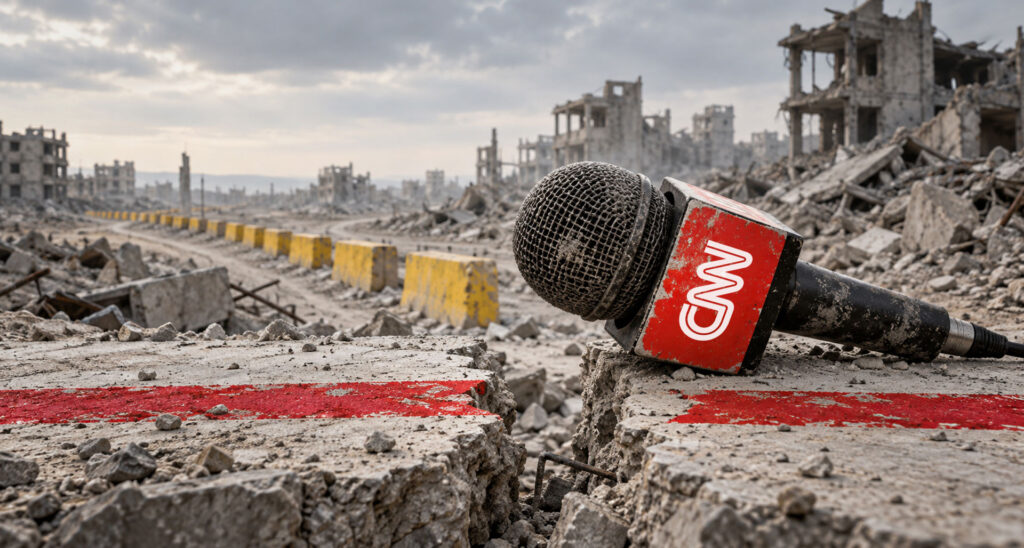
CNN’s report devotes considerable attention to the yellow line separating areas of Gaza under Israeli and Palestinian control. Yet when it comes to the credibility of the sources on which its reporting depends, the network appears to have no red lines at all.
Liked this article? Follow HonestReporting on Twitter, Facebook, Instagram and TikTok to see even more posts and videos debunking news bias and smears, as well as other content explaining what’s really going on in Israel and the region. Get updates direct to your phone. Join our WhatsApp and Telegram channels!
© Divuach Ne’eman R”A, 2025