Key Takeaways:
-
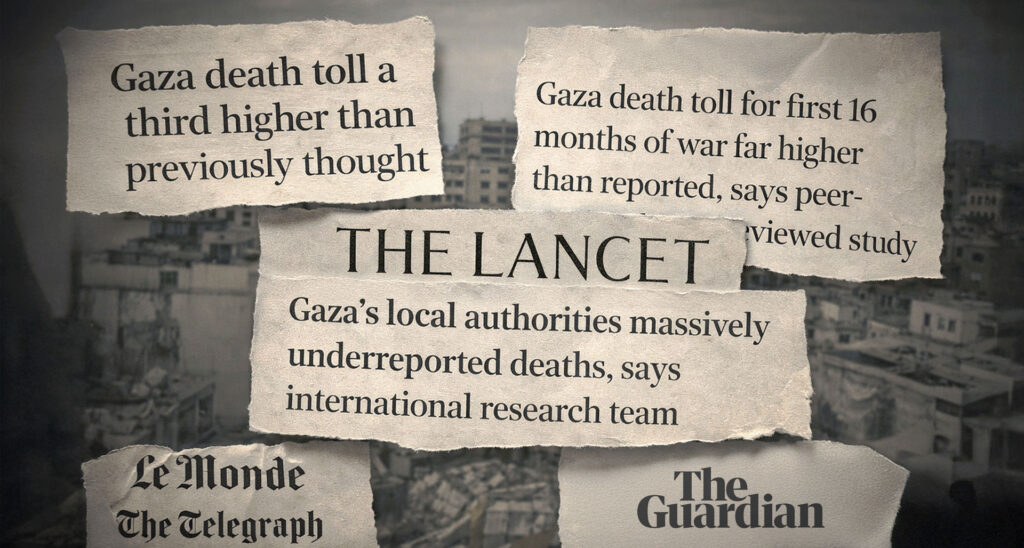
A new Lancet study estimated Gaza war deaths at roughly one-third higher than official figures, based on a survey of 2,000 households and statistical extrapolation.
-
Major outlets reported the estimate as a dramatic correction to Gaza’s death toll, often without clearly distinguishing between modeled projections and confirmed fatalities.
-
Independent analysts highlighted methodological flaws and reporting practices that complicated the casualty estimates, underscoring the need for far more careful coverage.
Another day, another dramatic Gaza death toll headline.
Last week, major outlets including The Guardian, The Telegraph, and Le Monde splashed claims that the true number of people killed in Gaza is far higher than previously reported, citing a new study in medical journal The Lancet — an unreliable publication with a history of anti-Israel bias, whose analysis methods were debunked in the past. In this latest case, readers were told the death toll could be roughly a third higher than official figures.
1/
Sigh… another day, another Lancet study purporting to prove that the Gaza death toll is higher than even the Hamas-run Gaza health ministry has claimed.@TheLancet keeps generating headlines like these. But let’s remind ourselves why it’s hardly a credible source. ? pic.twitter.com/QeRAA85PH5— HonestReporting (@HonestReporting) February 19, 2026
But much of the reporting blurred a critical distinction. The study presents a statistical estimate derived from survey data, which is based on faulty assumptions. And it does not offer a verified, name-by-name body count. That difference is not academic. It goes to the heart of responsible journalism.
The Lancet researchers surveyed roughly 2,000 households across Gaza and used statistical weighting to project nationwide mortality figures. Based on that modeling, they estimate approximately 75,200 violent deaths between October 7, 2023 and January 5, 2025. That is significantly higher than the roughly 49,000 deaths recorded by Gaza’s Hamas-run health authorities over the same period.
The study also estimates several thousand additional non-violent excess deaths attributable to the broader effects of war, including the collapse of healthcare services and infrastructure. Taken together, the projections suggest a death toll meaningfully higher than previously reported.
Given the media’s obsession with trying to prove Israeli wrongdoing, it’s not surprising that such findings are generating headlines. But they are also built on assumptions inherent in survey-based research conducted under extreme conditions, and this context should have been mentioned.
The authors themselves acknowledge uncertainty. They provide a wide range for violent deaths, spanning from roughly the low 60,000s to the high 80,000s. They note the challenges of conducting representative sampling in a territory marked by displacement, restricted access, and ongoing hostilities. They do not claim to have produced a definitive final count.
Yet many headlines treated the estimate as a correction to official figures rather than as one (flawed) model-based attempt to approximate reality.
Related Reading: 680,000 Dead in Gaza? Social Media Eats Up Nonsensical Analysis
Methodological Flaws
Conflict mortality studies often rely on sampling methods when full documentation is impossible. That approach can be valuable. It can also be fragile.
Household surveys depend on accurate reporting, stable sampling frames, and reasonable assumptions about representativeness. In a densely populated war zone with widespread displacement, each of those elements is complicated.
Independent commentators underscored these concerns. Mark Zlochin highlighted the methodological risks of extrapolating nationwide totals from limited household data in active conflict conditions.
² The study’s core idea is simple: survey 2,000 households, ask how many lived there before the war and how many died since, then scale up to estimate population-wide deaths.
It’s a standard method used in mortality surveys — with one crucial caveat common to all of them:Your…
— Mark Zlochin – מארק זלוצ’ין༝ (@MarkZlochin) July 12, 2025
HonestReporting board member Salo Aizenberg noted that in Gaza, families can report deaths even when a body has not been recovered, including cases listed as “under rubble,” and that such reporting may be linked to eligibility for financial compensation. He argued that studies and media coverage must explicitly address how these reporting practices could affect and twist fatality estimates.
Two pieces on Gaza fatalities today, in Lancet and @haaretz. Both have a major flaw: they don’t mention or contend with the fact that Gazans have reported deaths without a body all war and do so for compensation. Reporting form even has a choice “body under rubble.” @nirhasson https://t.co/59fgqxDMzj
— Aizenberg (@Aizenberg55) February 19, 2026
The Lancet has already proven itself to be an unreliable source tainted with an anti-Israel agenda. By now, the media should be thinking twice before publishing yet another piece of Lancet research. But if they are going to do so, the least that should be expected is to report the study with precision.
Every civilian death in Gaza is a tragedy. But journalism’s obligation is not simply to amplify striking figures. It is to examine how those figures were produced, what their margins of error are, and what remains unknown.
In this case, the study deserved a clearer explanation than many readers received.
When statistical estimates are presented without sufficient methodological context, public understanding narrows. And in a conflict as scrutinized and politically charged as Gaza, clarity is not optional. It is essential.
Liked this article? Follow HonestReporting on Twitter, Facebook, Instagram and TikTok to see even more posts and videos debunking news bias and smears, as well as other content explaining what’s really going on in Israel and the region. Get updates direct to your phone. Join our WhatsApp and Telegram channels!
© Divuach Ne’eman R”A, 2025