Key Takeaways:
- Over the past several days, the Iranian regime has fired missiles and drones at Gulf states.
- After Hezbollah broke the ceasefire with Israel, the IDF struck targets in Beirut. The Iranian regime then fired missiles toward Israel, claiming it was doing so in “defense” of Lebanon.
- The Iranian regime is only acting with its own interests in mind. It did not fire missiles to defend Lebanon, but rather to protect Hezbollah and continue the pursuit of its own interests, no matter what country it harms.
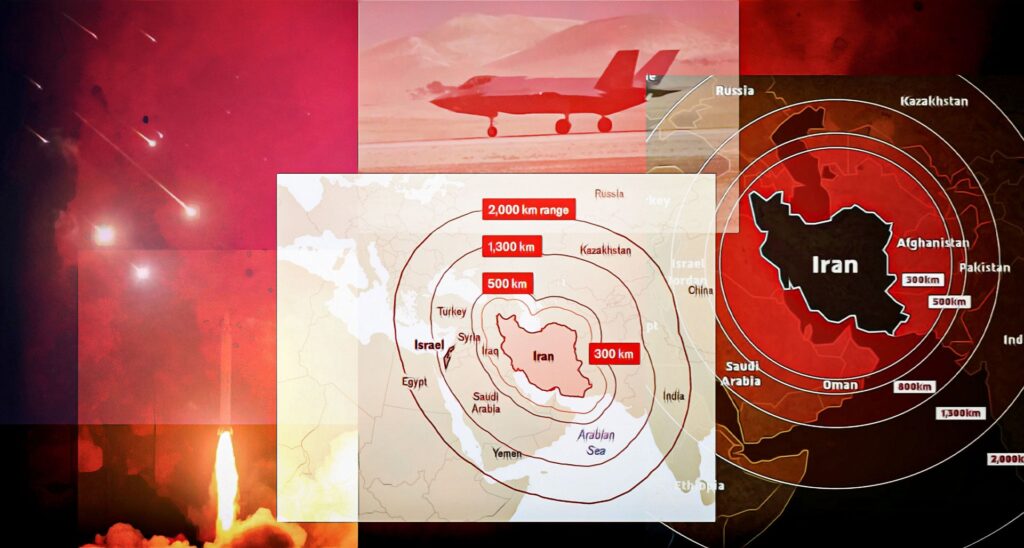
On June 7, 2026, Iran once again fired ballistic missiles at Israel, claiming the attack was carried out “in defense” of Lebanon following Israeli strikes in Beirut.
Almost immediately after the first missiles were launched, Iranian Foreign Minister Seyed Abbas Araghchi shared an image of the Iranian and Lebanese flags on social media, signaling that Tehran was portraying the attack as an act of solidarity with Lebanon.
— Seyed Abbas Araghchi (@araghchi) June 7, 2026
The Iranian Regime’s Recent Actions in the Gulf
Yet even before launching missiles at Israel, Iran had already been escalating its military activity elsewhere in the Middle East.
Since the beginning of June, the regime has intensified attacks across the Gulf region. On June 3, Kuwait International Airport was struck by Iranian missiles, killing one person and injuring several others. Days later, Iran launched another round of missiles toward both Kuwait and Bahrain.
As of June 6, 2026, the Gulf Research Center reported more than 7,000 Iranian missile and drone attacks against Gulf states since the ceasefire took effect. According to the data, nearly 3,000 attacks targeted the UAE, more than 1,000 each targeted Saudi Arabia and Kuwait, while Bahrain faced more than 700 attacks.
Iranian attacks on the GCC states and the Hashemite Kingdom of Jordan in the post-ceasefire phase (as of Jun 6, 2026):
A total of 7,069 attacks, including missiles and drones, reflecting a clear escalation in both the scale of operations and their geographic spread.#GCC #Iran… pic.twitter.com/dFz23ICjcD
— Gulf Research Center – مركز الخليج للأبحاث (@Gulf_Research) June 8, 2026
Since the ceasefire was implemented in April, Iran has repeatedly tested its limits while portraying itself as the aggrieved party whenever the United States responded to ceasefire violations that endangered American personnel and interests in the region.
What Tehran conveniently ignores is that launching missiles and drones at sovereign states, as well as targeting American forces and assets, constitutes a clear violation of the ceasefire itself.
Iranian Regime Attacks Israel for Its Own Interests
Before Israel struck Hezbollah targets in Beirut, the IDF had made clear that it would do so if Hezbollah continued violating the ceasefire agreement. Only after Hezbollah fired rockets at northern Israel did Israel respond with airstrikes on the Lebanese capital.
Tehran’s reaction was immediate. Iranian officials threatened a “painful and decisive response” to Israel over the strikes against Hezbollah – Iran’s most important, albeit significantly weakened, regional proxy.
Given Iran’s pattern of missile and drone attacks throughout the Middle East, it should be obvious that its launch of more than 20 missiles at Israel was not motivated by a desire to “defend” Lebanon. There was no threat to Lebanese sovereignty or Lebanese civilians that required Iranian intervention.
Rather, the attack was another manifestation of Iran’s long-running campaign against Israel and part of a broader strategy aimed at projecting power, maintaining regional influence and instability, and preserving its network of proxies.
That did not stop parts of the international media from adopting Iran’s framing.
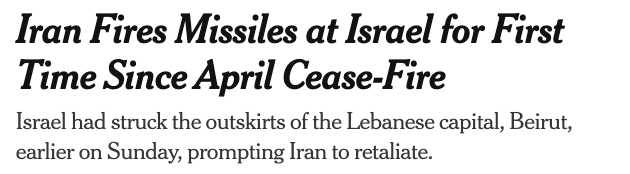
The New York Times, for example, reported that Israeli strikes in Beirut “prompted” Iran to “retaliate.”
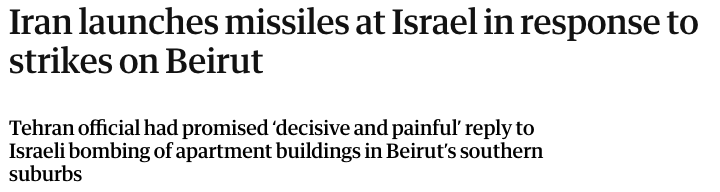
The Guardian similarly described Iran’s missile barrage as coming “in response” to Israeli strikes in Beirut.
But if Iran’s missile barrage was simply a reaction to Israeli military action in Beirut, how should readers interpret its simultaneous attacks on Kuwait, Bahrain, and other Gulf states?
The answer is that they cannot.
The claim that Iran was acting to “defend” Lebanon collapses when viewed alongside the regime’s broader regional behavior. A government genuinely concerned with Lebanese sovereignty would not use Lebanon as a base for an armed proxy force, nor would it simultaneously threaten neighboring countries across the Middle East.
Iran’s actions are driven by its own strategic interests. Hezbollah remains one of the regime’s most valuable tools for advancing those interests, regardless of the consequences for Lebanon itself.
Tehran may attempt to portray itself as a victim standing up for a neighboring state. But its record tells a different story.
This is not a story of defense.
It is the story of a regime willing to destabilize an entire region in pursuit of its ideological ambitions.
Liked this article? Follow HonestReporting on Twitter, Facebook, Instagram and TikTok to see even more posts and videos debunking news bias and smears, as well as other content explaining what’s really going on in Israel and the region. Get updates direct to your phone. Join our WhatsApp and Telegram channels!
© Divuach Ne’eman R”A, 2025