Key Takeaways:
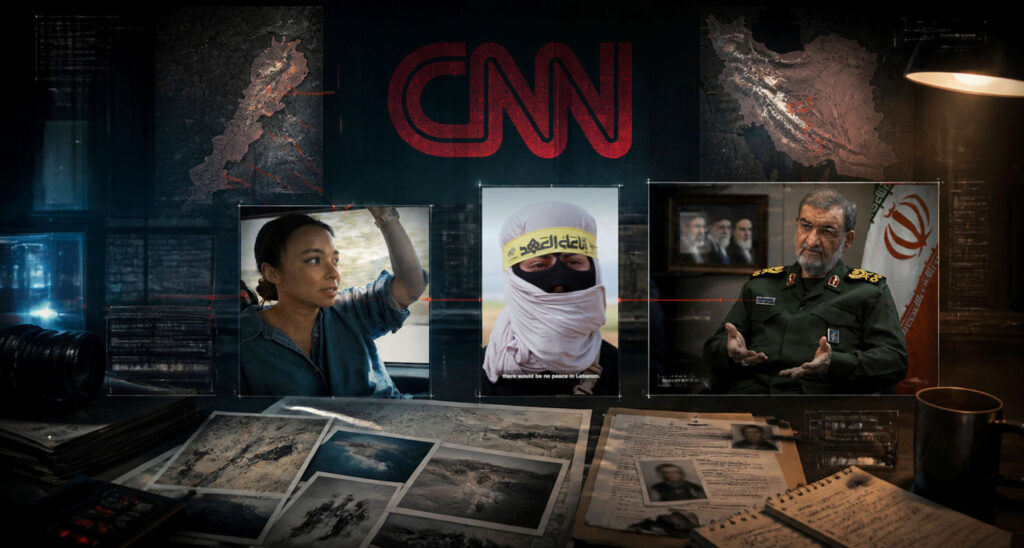
- CNN repeatedly grants sympathetic platforms to terrorists and Iranian regime officials without meaningful scrutiny. This includes recent interviews with a Hezbollah operative and Mohsen Rezaei, the senior military advisor to Iran’s supreme leader, Mojtaba Khamenei.
- In both interviews, the CNN journalists did not question the statements provided by the interview subjects, raising concerns about how access to Iran and Hezbollah-dominated areas are given and maintained.
- Together, these two pieces paint a broader picture of how CNN is prioritizing access over rigorous journalistic standards.
Are two weeks of reporting filled with propaganda interviews with terrorists and agenda-driven narratives merely a coincidence? Or are they part of a larger – and far more problematic – pattern?
Looking at CNN’s recent coverage raises precisely these questions.
A Meet-And-Greet With Hezbollah
“Elusive” is perhaps not the first adjective a rational and neutral news outlet would use to describe Hezbollah. Yet, that is exactly how a Hezbollah “fighter” is described by CNN’s Isobel Yeung in an exclusive interview published this past week.
In the interview, Hezbollah is recast through the lens of a legitimate organization seeking to protect Lebanon from occupiers. Hezbollah’s standing as a terrorist organization and its role in destabilizing Lebanon as it drags the country into countless wars are not acknowledged in the interview. Nor are the civilians who have lost their lives because of the terrorist threats Hezbollah poses.
1/
This might be one of the most disturbing CNN segments on Hezbollah you’ll see this year.A Hezbollah terrorist is cast as an “elusive fighter” in a soft‑focus human‑interest profile – not as a member of a US‑designated terrorist organization. ? pic.twitter.com/P5RcbZTeCW
— HonestReporting (@HonestReporting) June 5, 2026
Instead, Yeung focuses her questions on why her interview subject joined Hezbollah, how the death – or “martyrdom” as the terrorist refers to it – of other Hezbollah terrorists makes him feel, and whether or not “firing [rockets] towards Israel and Israeli troops is going to create a safer Lebanon.”
The questions effectively create a platform for the terrorist to justify his actions – and Hezbollah’s more broadly – knowing that he will not be met with any pushback. The rockets that are merely “fired” towards Israel are not contextualized as threats that have indiscriminately killed Israeli civilians.
2/
These are the first two questions:
“Why did you join Hezbollah?”
“You’ve seen a lot of fighters die. How does that make you feel?”That’s talk‑show therapy language for a man who boasts about “martyrdom” – not serious journalism.
He answers that he envies dead fighters and… pic.twitter.com/xDymTEqAGM
— HonestReporting (@HonestReporting) June 5, 2026
The result is an interview that largely serves as a platform for a Hezbollah operative to rationalize terrorism to a Western audience. Given Yeung’s past reporting from Lebanon when the war ticked up again in March, it is perhaps unsurprising that she was able to secure such exclusive access. More troubling, however, is that the access appears to have come at the expense of basic journalistic skepticism, allowing Hezbollah’s narrative to reach viewers largely unchallenged.
This points to a larger and unmentioned caveat: journalists reporting from Hezbollah-controlled areas, or speaking with such terrorists, are required to follow Hezbollah’s rules. And, as CNN has now shown on multiple occasions, it is more than willing to do so.
Meeting with Khamenei’s Advisor
It is not only in Lebanon that CNN uncritically platforms terrorists. In Iran, Frederik Pleitgen has similarly gained access to the most senior officials in the Iranian regime.
During the Israel-Iran wars in June 2025 and in March 2026, Pleitgen entered the country, reporting from the ground, interviewing pro-regime citizens, and Kamal Kharazi, the Foreign Policy Advisor to the office of the Supreme Leader. The coverage presented the regime through a sanitized lens, ignoring the brutal crackdown on civilians and the Iranian regime’s intent to destroy Israel.
That regime-controlled access has afforded Pleitgen another exclusive interview, this time with Mohsen Rezaei, the senior military advisor to Iran’s supreme leader, Mojtaba Khamenei.
“Trump must make decisions independently of Israel, stop the blockade and release our frozen assets.”
Top adviser to Iran’s supreme leader tells @fpleitgenCNN in exclusive interview that a meeting between Trump and Khamenei “will not happen.”
More https://t.co/XzPmXP3m4f pic.twitter.com/Er7bi2aQKQ
— CNN International PR (@cnnipr) June 5, 2026
Unsurprisingly, then, the interview did not include any pushback or even questions about how the regime has been treating its civilians, who, until recently, were under an internet blackout that lasted nearly 90 days.
Nor is Rezaei’s own record questioned. Rezaei, who is thought to have potentially ordered the murder of his own son in 2011, is also wanted by Argentine authorities for his involvement in the terrorist attack at the AMIA Jewish Community Center in Buenos Aires in July 1994, which claimed the lives of 85 people.
With such a high position and as the former commander of the Islamic Revolutionary Guard Corps (IRGC), Rezaei would have taken an active role in the brutality that struck the country’s civilians.
But to get such an interview placement, CNN’s Pleitgen merely nods along and stays quiet, not daring to ask the questions that would revoke his access.
The Future of CNN
When examined together, these pieces and the journalists publicizing them do not reflect small editorial mishaps but a larger pattern of CNN’s reporting and the direction the outlet is heading. It is a direction that frequently platforms terrorists and Iranian regime members with sympathy, rewarding and promoting the access that such platforms provide.
When CNN trades the truth for exclusivity, journalistic integrity is the price they pay.
Liked this article? Follow HonestReporting on Twitter, Facebook, Instagram and TikTok to see even more posts and videos debunking news bias and smears, as well as other content explaining what’s really going on in Israel and the region. Get updates direct to your phone. Join our WhatsApp and Telegram channels!
© Divuach Ne’eman R”A, 2025