Key Takeaways:
- In international reporting, casualty numbers from Lebanon rarely break down the civilian to combatant deaths.
- The IDF has targeted 2,500 Hezbollah terrorists, making the civilian-to-combatant ratio roughly 1:3, an incredibly low ratio for modern and urban warfare.
- By omitting Hezbollah’s casualties in their reports, the media misrepresents the war in Lebanon, as Israel is portrayed as intentionally targeting civilians.
Throughout the Israel-Hamas war, the media consistently relied on the Hamas-run Ministry of Health (MoH) in Gaza to provide casualty figures, frequently taking its claims at face value without examining their reliability. This was especially problematic because the MoH deliberately refused to distinguish between combatants and civilians.
The reason was clear: By collapsing civilians and terrorists into a single casualty count, Hamas could maximize international sympathy while advancing the narrative that Israel was deliberately targeting innocent civilians.
A similar pattern is now emerging in Lebanon.
Since March 2, 2026, after Hezbollah launched rockets at Israel and joined the Iranian regime’s attack on the Jewish state, the IDF has conducted extensive operations aimed at removing the terrorist threat along Israel’s northern border and beyond.
Yet when casualty figures appear in major international media outlets, the numbers are typically reported as a single undifferentiated total. As in Gaza, Hezbollah operatives are rarely separated from civilians.
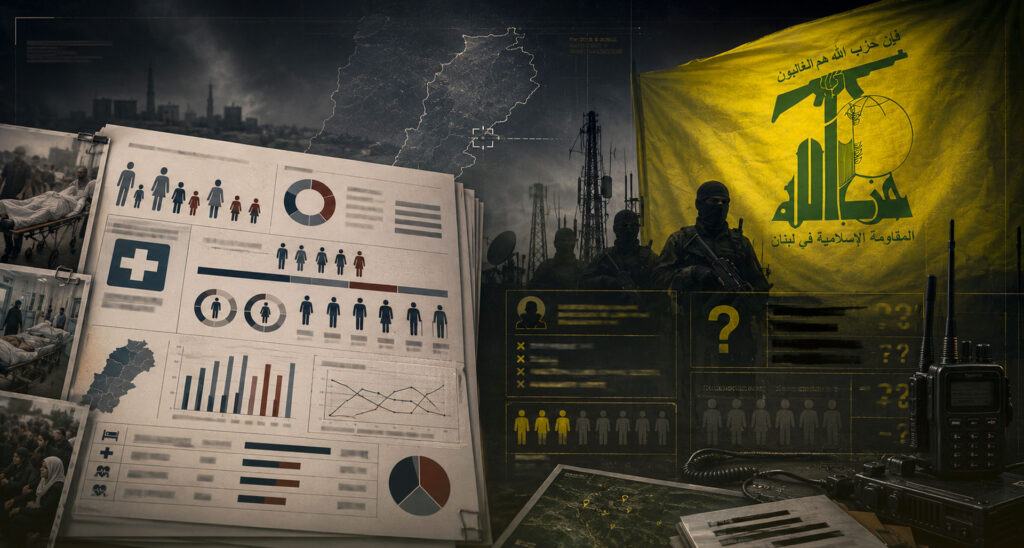
The IDF recently revealed that it has targeted 2,500 Hezbollah operatives since the war resumed in March. This is in addition to the 7,000–8,000 Hezbollah terrorists reportedly killed since October 8, 2023. According to the IDF, these losses amount to roughly one-third of Hezbollah’s pre-war fighting force.
Meanwhile, as of June 1, 2026, the Lebanese Health Ministry reported approximately 3,300 total fatalities.
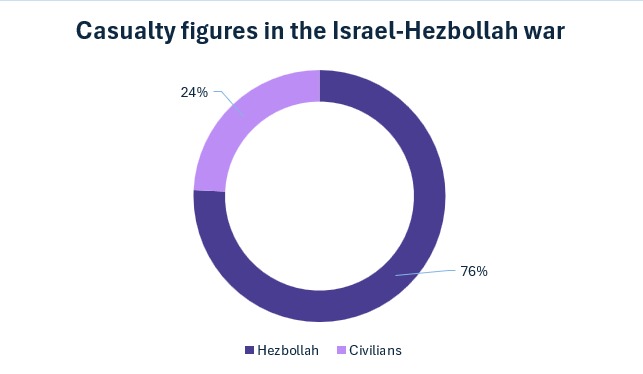
Graph based on IDF casualty figures.
Based on these figures, approximately 76% of all reported fatalities were Hezbollah terrorists, producing a civilian-to-combatant ratio of roughly 1:3.
That is a remarkably low ratio by the standards of modern warfare. It is even more notable given Hezbollah’s well-documented practice of embedding fighters, weapons, and military infrastructure within civilian areas.
Related Reading: The Real “Gaza Model”: How Hamas and Hezbollah Tactics Shape the Battlefield
Even Hezbollah officials have acknowledged that “several thousand” of the group’s fighters have been killed.
This @Reuters report reveals more than Hezbollah’s heavy losses after going to war with Israel on March 2.
It exposes a clear contradiction.Hezbollah officials admit “several thousand” fighters have been killed — while the group’s own media office denies it.
Same… pic.twitter.com/kErwySxTDE
— HonestReporting (@HonestReporting) May 5, 2026
Yet this crucial context is almost entirely absent from the casualty figures routinely appended to news reports by major international outlets.
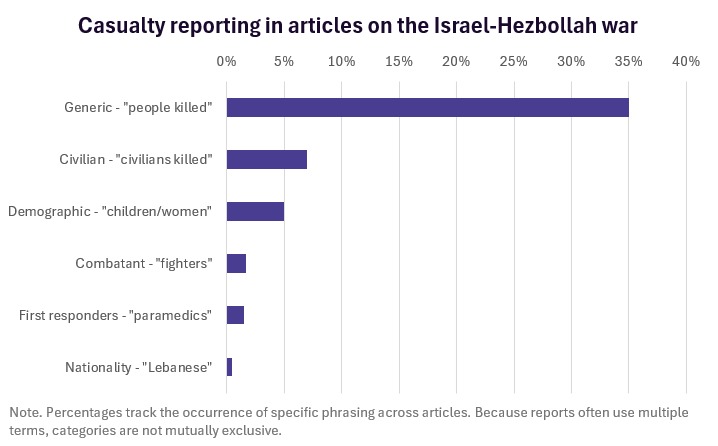
Graph based on data from HonestReporting.ai Labs.
According to analysis conducted by HonestReporting.ai Labs, of 2,397 articles published between March 1 and May 31, 2026, approximately 35% described the fatalities simply as “people,” while another 7% referred to them as “civilians.” Hezbollah casualties were explicitly identified in fewer than 2% of all articles analyzed.
An additional 5% of articles singled out women and children, while men were never separately identified.
This framing matters.
When combatants and civilians are merged into a single casualty figure, the nature of the conflict is fundamentally altered in the eyes of readers. The resulting impression is one of indiscriminate targeting and disproportionate force.
Yet the available evidence points in a different direction.
The casualty statistics themselves suggest that the IDF’s operations are overwhelmingly directed at terrorist infrastructure and operatives rather than civilians. The military’s stated objective remains the dismantling of Hezbollah’s military capabilities while minimizing collateral damage, and the casualty ratios appear consistent with that goal.
The media’s own reporting has often unintentionally reinforced this reality. Journalists have repeatedly shown funerals draped in Hezbollah flags and insignia, documented Hezbollah supporters returning to southern Lebanese towns, and reported on the group’s use of civilian infrastructure.
Hezbollah itself has held countless public funerals for its operatives, many of them attracting significant media attention.
Mass funerals in Lebanon reflect the scale of Hezbollah’s losses
In recent weeks since the ceasefire, there has been a growing number of reports from across Lebanon documenting mass funerals of Hezbollah operatives, taking place simultaneously in multiple locations. These events… pic.twitter.com/zSZHhTalgd
— Israel-Alma (@Israel_Alma_org) May 3, 2026
Why, then, is this context so often absent from casualty reporting when the evidence is hiding in plain sight?
Nor is this phenomenon limited to the current phase of the war.
Following the pager attack in September 2024, for example, the Associated Press described confirmed Hezbollah casualties as “civilians.”
Are these the ‘enormous number of civilian casualties’ you’re talking about, @AP?
Let’s set the record straight: vast majority of those killed in the walkie-talkie/pager attacks were terrorists, as even Hezbollah admits.
Correct this misinformation immediately, @AP pic.twitter.com/9m0iITV5IU— HonestReporting (@HonestReporting) September 20, 2024
Repeating casualty figures without identifying who those casualties are deprives readers of the information necessary to understand the conflict. The distinction between combatant and civilian is not a minor detail; it is central to assessing proportionality, military conduct, and the nature of the war itself.
Every civilian death is a tragedy.
But when the media presents aggregate casualty figures stripped of context, while omitting overwhelming evidence that a large majority of those killed were Hezbollah operatives, it risks reinforcing a misleading narrative. Whether intentional or not, such reporting mirrors Hezbollah’s own interest in obscuring the distinction between terrorist fighters and civilians, ultimately leaving audiences with a distorted picture of both the war and Israel’s objectives.
Liked this article? Follow HonestReporting on Twitter, Facebook, Instagram and TikTok to see even more posts and videos debunking news bias and smears, as well as other content explaining what’s really going on in Israel and the region. Get updates direct to your phone. Join our WhatsApp and Telegram channels!
© Divuach Ne’eman R”A, 2025