Key Takeaways
- Pep Guardiola’s comments on Gaza demonstrate how emotionally charged imagery now functions as moral authority, even for global figures with no direct experience of the conflict.
- The same Gaza image ecosystem examined throughout this series is shaping elite opinion far beyond journalism, influencing public discourse through repetition rather than verification.
- When influential voices rely on uncontextualized imagery produced within a closed media environment, visual bias migrates from news coverage into global moral judgment.
Last week, Pep Guardiola, the manager of English Premier League soccer club Manchester City, spoke publicly about Gaza, citing images he had seen as the basis for his moral position. His remarks were reported globally within hours, amplified across sports media, mainstream news outlets, and social platforms well beyond the soccer world.
Guardiola did not present himself as a regional expert, a policy analyst, or a witness. His authority rested on something simpler and increasingly powerful: the images.
This matters because Guardiola is not an unusual case. He is illustrative.
Across the previous twelve articles, this series has documented how imagery from Gaza is produced, selected, captioned, and distributed through a highly constrained visual ecosystem. Those same images are now shaping not only news coverage, but the moral language of cultural elites whose words carry extraordinary reach.
Guardiola’s intervention offers a clear case study in what happens when visual narrative replaces contextual understanding.
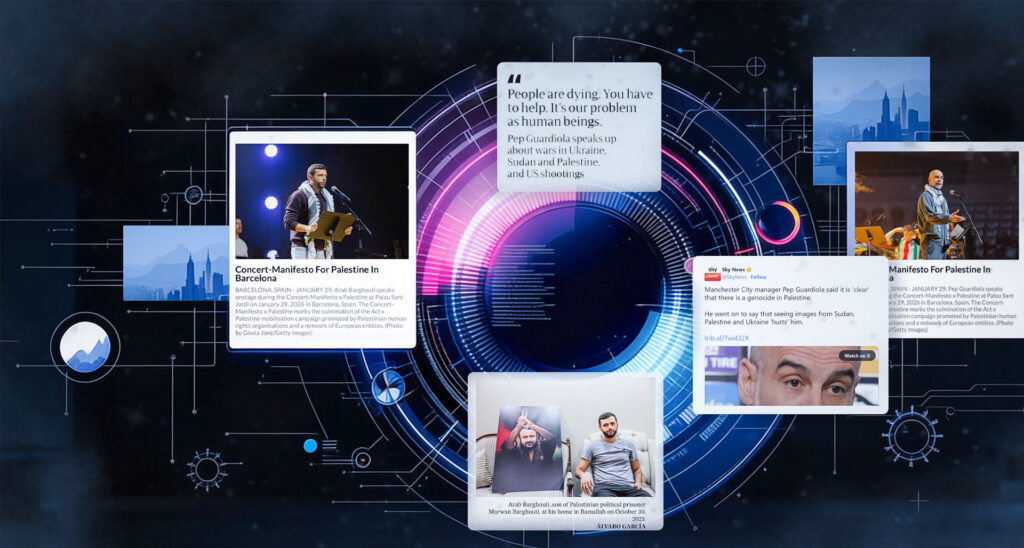
Manchester City manager Pep Guardiola said it is ‘clear’ that there is a genocide in Palestine.
He went on to say that seeing images from Sudan, Palestine and Ukraine ‘hurts’ him.https://t.co/Nzi5VvRBJH pic.twitter.com/88KsLRLDtE
— Sky News (@SkyNews) February 4, 2026
Who Does Guardiola Speak For?
Pep Guardiola is not a private citizen speaking in isolation. He is one of the most visible figures in global sport, managing a club owned by City Football Group, which is majority controlled by Abu Dhabi United Group, an Abu Dhabi–based investment entity.
This is not incidental context. Guardiola’s salary, platform, and global visibility are inseparable from the institutional structures that employ him. Manchester City is not merely a soccer club; it is part of a state-linked sports and branding ecosystem operating within complex geopolitical realities of the Middle East.
This article does not suggest that Guardiola’s comments were directed, coordinated, or influenced by ownership. It establishes something more basic and more defensible: when a figure of this stature speaks, he does so from within a powerful institutional framework, not outside it.
That framework shapes how remarks are received, amplified, and interpreted.
Images as Moral Shortcut
Guardiola framed his comments around what he had seen. This is now a dominant mode of discourse on Gaza.
Images are treated as self-evident proof, requiring no interrogation of sourcing, access, or framing. Viewers are not asked where the images came from, under what conditions they were taken, or what remains outside the frame. The visual alone is assumed to convey truth.
Yet the previous articles in this series have shown that Gaza imagery is overwhelmingly supplied by a small pool of repeat photographers operating under Hamas control, within a territory where independent access is impossible and deviation carries severe risk.
When such imagery is consumed without scrutiny, it ceases to inform and begins to instruct. It becomes not evidence, but authority.
Guardiola’s remarks illustrate how quickly emotional response hardens into moral certainty when images are allowed to speak alone.
The Barcelona Event and Its Symbolic Context
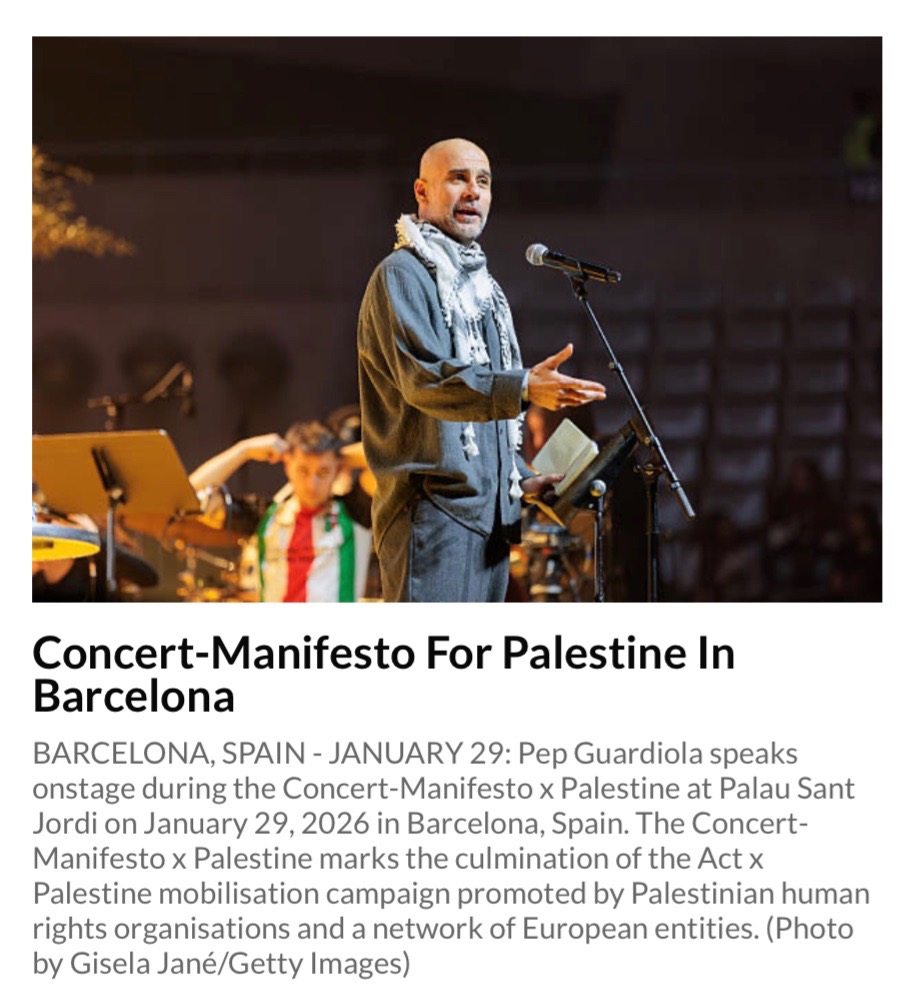
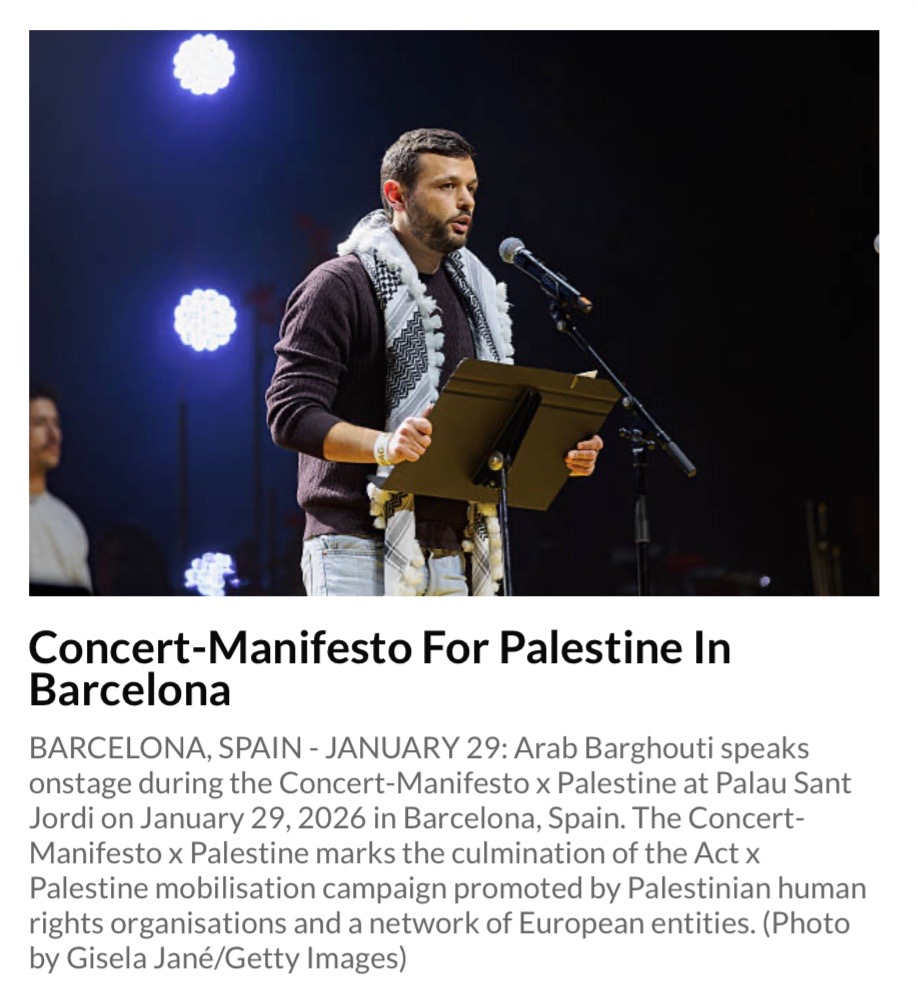
Guardiola’s comments were delivered at a public event in Barcelona framed around Palestinian advocacy. Reporting from the event confirms that the son of Marwan Barghouti was present on the platform.
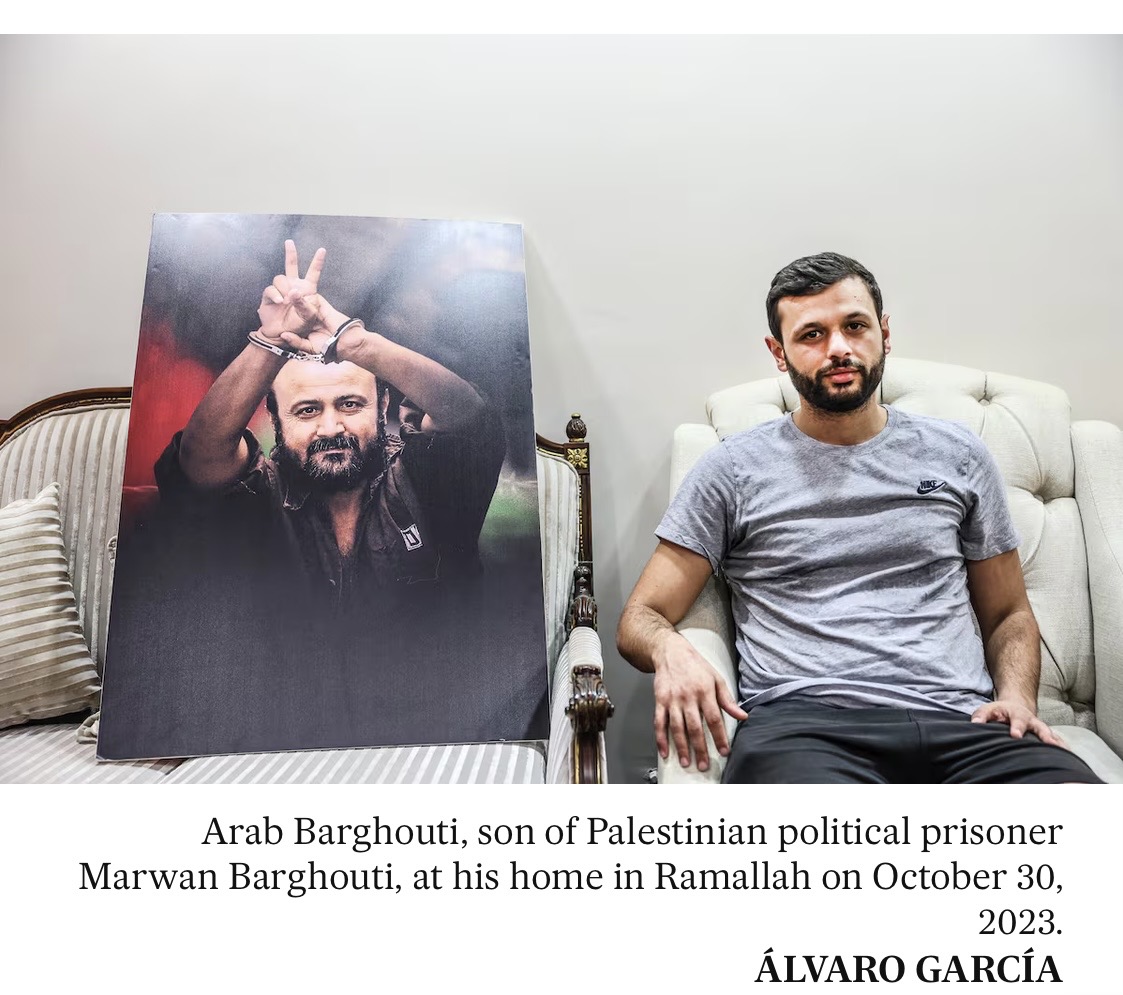
Marwan Barghouti is a senior Fatah figure serving multiple life sentences in Israel for involvement in terrorist attacks that killed five Israeli civilians. His son is frequently presented internationally as a political advocate and symbol of Palestinian suffering.
This article does not conflate familial presence with endorsement. It does not allege coordination, agreement, or shared intent.
But context matters.
Public platforms communicate meaning through symbolism as much as speech. The presence of figures connected to violent histories is relevant when discussing how narratives are framed, received, and legitimized — particularly when imagery already dominates moral interpretation.
Notably, most media coverage of Guardiola’s remarks omitted this context entirely.
Speaking Without Witness
There is no public record of Guardiola having visited Gaza, the West Bank, or Israel in any reporting, humanitarian, or professional capacity. That absence is not a criticism. It is a clarification.
Guardiola speaks not as a witness, but as a viewer — like millions whose understanding of the conflict is mediated almost entirely through images selected and distributed by global news agencies.
This reinforces the central finding of this series: visual access has become a proxy for truth, even when that access is structurally constrained and politically shaped.
Why This Extends Beyond Football
The issue is not whether Pep Guardiola is entitled to express empathy or opinion. It is why his words carry such immediate moral weight, and what that reveals about the contemporary media environment.
When globally influential figures rely on imagery alone:
- Editorial bias is translated into moral language
- Structural omissions become invisible
- Emotional urgency replaces analytical restraint
What begins as compassion risks becoming absolutism – not because people are malicious, but because the visual ecosystem they trust is incomplete.
When Images Set the Moral Map
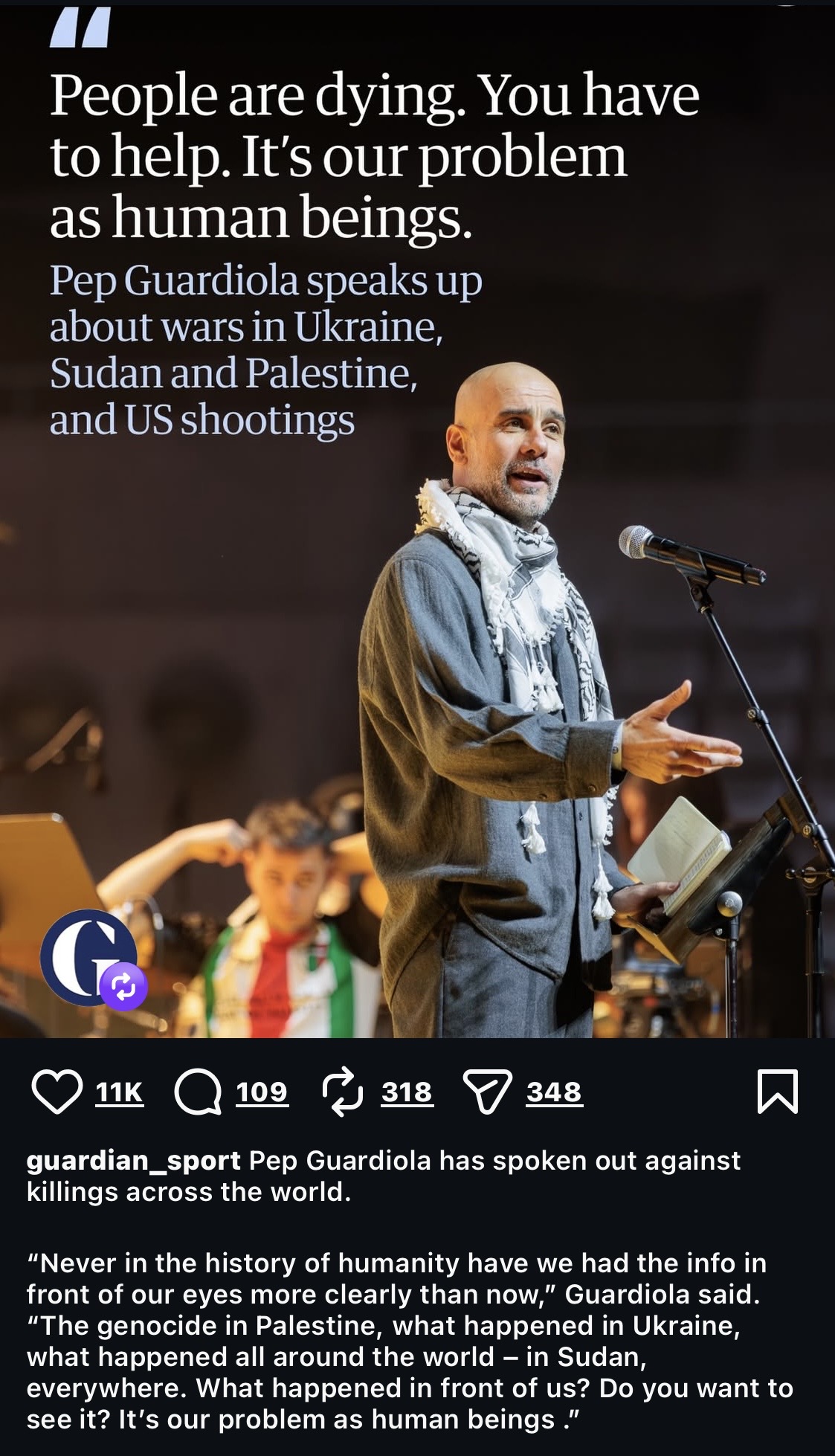
At the Barcelona event, Guardiola appeared on stage wearing a keffiyeh, a visual symbol that carries explicit political meaning, while explaining that his decision to speak was driven by what he had seen. “Never in the history of humanity have we had the info in front of our eyes more clearly than now,” he said. “When I see the images, I am sorry, it hurts. It hurts me.”
The platform also featured Arab Barghouti, the son of Marwan Barghouti, a senior Fatah figure serving multiple life sentences in Israel for involvement in terrorist attacks that killed five Israeli civilians. This article does not equate presence with endorsement. But the juxtaposition matters.
Screenshot
Guardiola spoke emotionally about Palestine, referenced Sudan, and invoked global suffering more broadly, yet made no mention of Iran, where mass repression, executions, and enforced visual silence continue largely unseen. The pattern is consistent with the findings of this series: moral urgency follows where images circulate, and the absence of imagery quietly removes entire populations from the ethical conversation.
Screenshot
Conclusion
Pep Guardiola did not create the Gaza image economy. He inherited it.
But his comments expose its power.
When images produced inside a closed, controlled media environment become the primary source of moral knowledge for influential voices, journalism loses its mediating role. Context collapses. Complexity disappears. Judgment accelerates.
This series has shown how Gaza imagery is made, framed, and repeated. This article shows what happens next: those images leave the newsroom and enter the global conscience, unchallenged and decisive.
The danger is not that people care.
The danger is that they care only about what they are shown, and mistake visibility for truth.
Liked this article? Follow HonestReporting on Twitter, Facebook, Instagram and TikTok to see even more posts and videos debunking news bias and smears, as well as other content explaining what’s really going on in Israel and the region. Get updates direct to your phone. Join our WhatsApp and Telegram channels!
© Divuach Ne’eman R”A, 2025