Key Takeaways:
- British Vogue wrote a profile on UN Special Rapporteur Francesca Albanese, without explaining her history of antisemitic comments, conspiracy theories, and support for terrorism.
- By excluding vital context of Albanese’s views, readers are left to believe that Albanese is assisting in the Palestinian cause, rather than hurting the Jewish people worldwide.
- Because British Vogue is not a traditionally political outlet, the audience it reaches is likely to be uninformed of the security challenges Israel faces and how Albanese’s work attempts to undermine that.
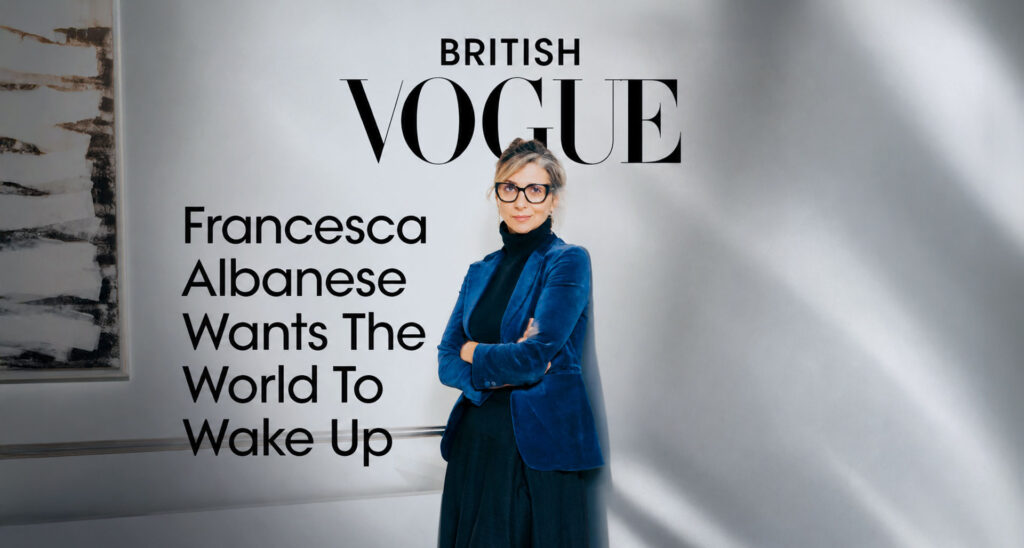
Francesca Albanese wants the world to wake up.
But with a glamorous profile in British Vogue of the UN Special Rapporteur on the “Occupied Palestinian Territories,” it would seem that the world has woken up and is being invited to view Albanese as a figure of admiration doing crucial work for the Palestinian people.
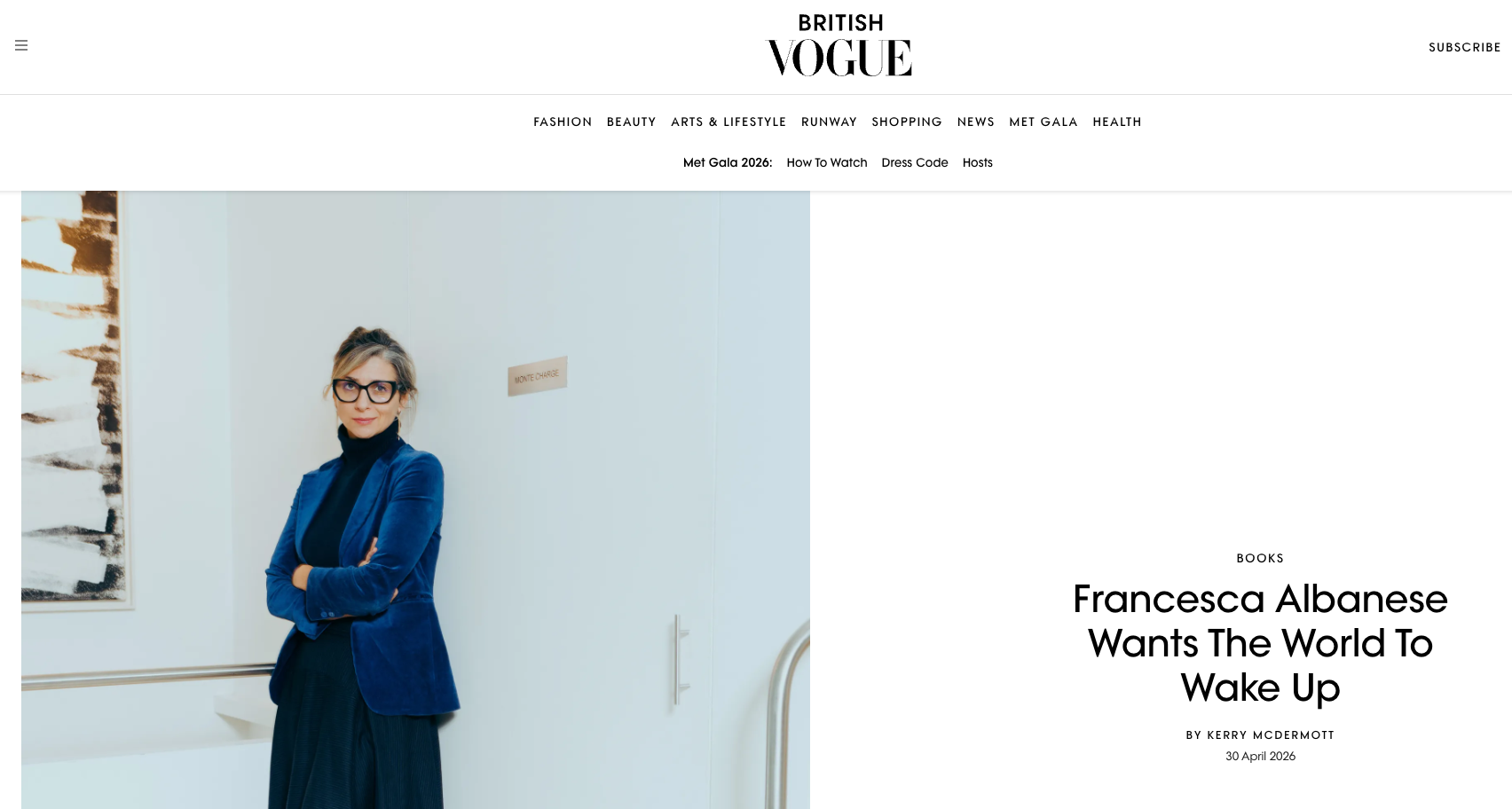
Yet Vogue’s spread omits Albanese’s well-documented record of antisemitism, conspiracy-mongering, and pro-terror rhetoric. These are not peripheral concerns; they are central to understanding how she has built her platform and reputation.
Instead, readers are presented with a carefully curated image that leaves this reality out of the frame.
The media is calling Francesca Albanese a “critic of Israel,” but she’s not.
She’s an antisemite, a terror apologist, and a fraud.? @unwatch @hillelneuer pic.twitter.com/uwpU2FU2z1— HonestReporting (@HonestReporting) July 11, 2025
Albanese tells Vogue that it is “not [about] me, it’s [about] what I’m doing.” But what she is doing is not advancing Palestinian interests in international forums— it is amplifying narratives that demonize Jews.
Long before her appointment as UN Special Rapporteur, her remarks claiming that a Jewish lobby subjugates the United States and her assertion at a Hamas-linked conference that the terror group has a “right to resist” should have triggered international condemnation. Instead, since assuming her role, the frequency and reach of such rhetoric have only increased.
Far from limiting her influence, this record has coincided with growing media amplification — not scrutiny.
So when Vogue writes that “the prospect of fame probably wasn’t one of [her reservations],” it ignores how Albanese has leveraged that fame to promote anti-Jewish narratives.
Her recent appearance at the Al Jazeera Forum illustrates the point. There, she invoked classic antisemitic tropes, suggesting the existence of a shared global enemy — echoing age-old conspiracy theories about Jewish power and influence.
When she is not promoting conspiracies, she is spreading demonstrably false claims to a global audience.
In the summer of 2024, Albanese and others within UN Special Procedures helped advance the false narrative of famine in Gaza — despite the IPC Famine Review Committee finding no such famine.
Then, in January 2025, she claimed that Israel had killed 380,000 children under the age of five in Gaza — a figure that is mathematically impossible, given that the total population of children under five prior to the war was 341,790.
View this post on Instagram
None of this appears in Vogue’s profile — because acknowledging it would fundamentally undermine the narrative being constructed.
Even within the article itself, Vogue fails to apply basic scrutiny to figures it highlights. Dr. Ghassan Abu-Sittah, featured in Albanese’s forthcoming book, is presented without context.
Like Albanese, Abu-Sittah has promoted anti-Israel conspiracy theories while receiving widespread media praise. He has also echoed sympathetic narratives about Hamas terrorism.
Yet Hamas itself is conspicuously absent from Vogue’s profile.
When the article notes that the Israel Albanese encountered in 2012 “no longer exists,” and references the devastation in Gaza since October 2023, it omits the cause: the Hamas-led massacre that triggered the war, and the group’s continued role in shaping the reality of life in Gaza.
This omission is not incidental. It reflects a broader pattern — one that extends far beyond Vogue — in which Albanese is consistently framed in sympathetic terms.
Only when the U.S. sanctioned Albanese did significant media backlash emerge — and even then, the outrage focused not on her rhetoric, but on the supposed silencing of a “critic of Israel.”
Vogue is not alone. Politico, The New York Times, and The Guardian have all contributed to a steady stream of soft-focus coverage that normalizes her rhetoric.
What makes Vogue’s contribution particularly concerning is its audience. Unlike traditional news outlets, it reaches readers who may lack the context to critically assess Albanese’s record.
Stripped of that context, the profile presents a “trailblazer” — not a figure whose statements and conduct demand serious scrutiny.
And for that, perhaps British Vogue should stick to fashion.
Liked this article? Follow HonestReporting on Twitter, Facebook, Instagram and TikTok to see even more posts and videos debunking news bias and smears, as well as other content explaining what’s really going on in Israel and the region. Get updates direct to your phone. Join our WhatsApp and Telegram channels!
© Divuach Ne’eman R”A, 2025